
World Cup 2026 Specials and Prop Bets — Beyond the Usual Markets
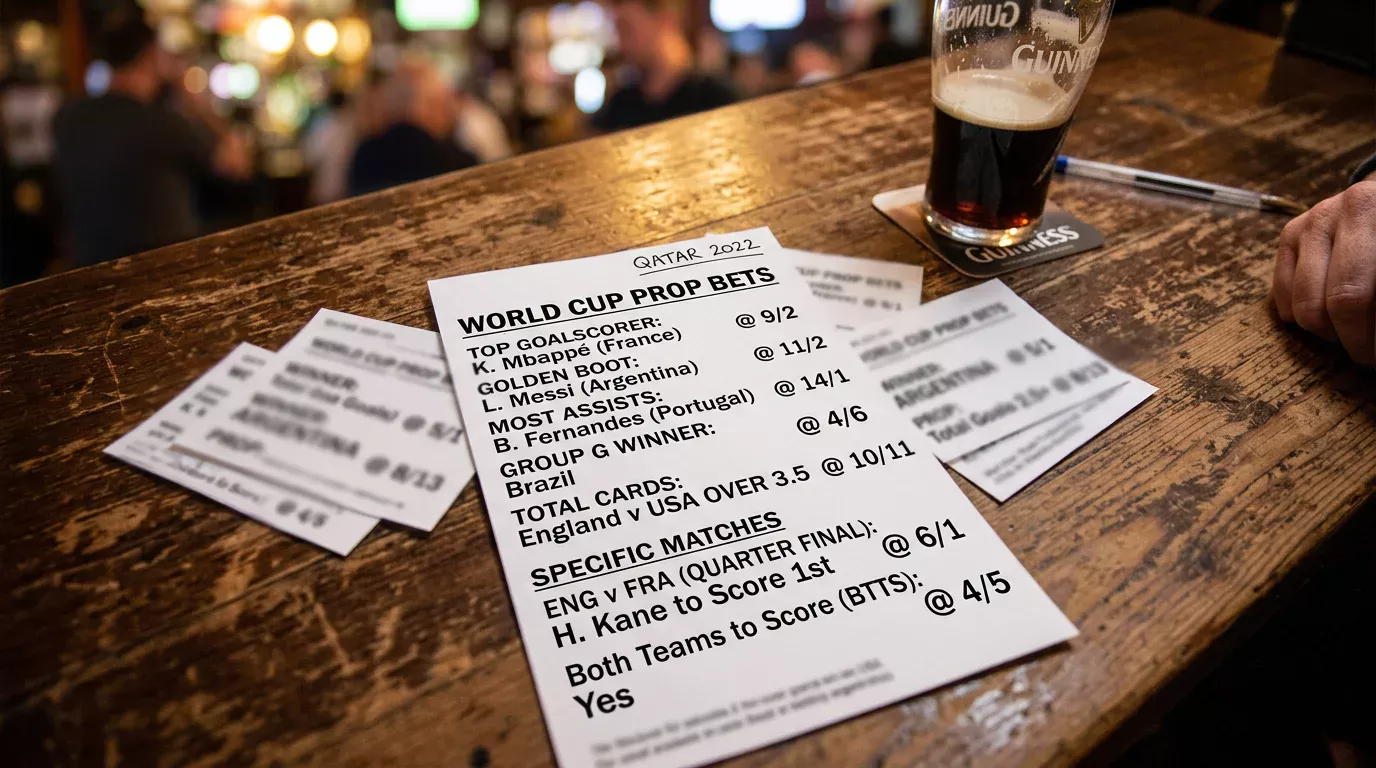
Will the first red card of the tournament come before the 30th minute? Will there be more goals scored in Group C than in Group J? Will a substitute score in the World Cup final? These are the kinds of questions that keep a World Cup interesting at 2am Irish time when you’ve already lost your outright bet on Spain and your accumulator died in the Round of 32.
World Cup 2026 prop bets — also called specials — are the betting markets that exist outside the standard match result, top scorer, and outright winner categories. They range from statistically grounded propositions to outright novelty. And while serious punters sometimes dismiss them as gimmicks, I’ve seen prop bets deliver better returns than any outright market at the last three World Cups I’ve covered. The trick is knowing which specials have genuine analytical value and which are just the bookmaker having a laugh at your expense.
What Are Prop Bets and Specials?
I had a mate who bet on the total number of corners in the 2018 World Cup final. France vs Croatia. He calculated the average corners per match for both teams throughout the tournament, adjusted for the final being a tighter affair, and landed on the over. He won. It wasn’t glamorous, it wasn’t the kind of bet you brag about in the pub, but it paid for his weekend. That’s a prop bet.
A proposition bet — prop bet for short — is any wager on a specific occurrence within a match or tournament that isn’t directly tied to the final result. At match level, this includes markets like first goalscorer, number of cards, number of corners, time of first goal, both teams to score, exact score, and dozens of variations. At tournament level, specials expand into territory like the overall number of goals scored across all 104 matches, the group with the most goals, which team will receive the most red cards, and whether any match will go to penalties in the group stage.
The distinction between a prop bet and a standard market is blurry. “Both teams to score” started as a special and is now so mainstream that it’s listed alongside 1X2 on every bookmaker’s match page. The market evolves, and what’s considered a novelty at one World Cup becomes standard at the next. For 2026, with 48 teams and 104 matches — the most in World Cup history — the range of available specials will be enormous.
Irish bookmakers like Paddy Power and BoyleSports have historically been aggressive with their specials offerings, often creating markets that don’t exist elsewhere. Paddy Power in particular has built a brand around novelty bets, and I’d expect their 2026 World Cup specials to be the most extensive on the market. If you’re looking for a specific prop bet and your current bookmaker doesn’t offer it, check theirs.
Most Popular World Cup Specials
Not all specials are created equal. Some have genuine analytical backing, others are pure luck. Let me separate the wheat from the chaff.
Tournament total goals is a market I always look at first. The 2022 World Cup in Qatar produced 172 goals across 64 matches, an average of 2.69 per game. The 2026 World Cup will feature 104 matches. If the goals-per-game average holds steady, you’d expect around 280 total goals. But the expanded format introduces more matches between mismatched teams in the group stage — think Germany vs Curaçao or France vs Iraq — which historically produce higher-scoring results. I’d estimate the total in the range of 275-295, and any over/under line set below 275 looks like a strong over to me.
First goal of the tournament is a fun one because it’s settled within the first 90 minutes. Mexico play South Africa in the opening match at Estadio Azteca on 11 June. Bookmakers will offer odds on which player scores first, what minute it comes in, and whether it’s from open play, a set piece, or a penalty. Historically, the opening match of a World Cup tends to be tight and cagey — four of the last six openers produced two goals or fewer — so “under 2.5 goals in the opening match” is a quiet special that’s hit more often than not.
Group winner and group stage specials are the markets with the most analytical value. You can bet on which team tops each group, the exact finishing order of a group, the number of goals in a specific group, and whether all four teams in a group will score at least once. I particularly like group-specific goal totals because they allow you to target unbalanced groups where the talent disparity should produce high-scoring matches. Group E (Germany, Curaçao, Côte d’Ivoire, Ecuador) and Group J (Argentina, Algeria, Austria, Jordan) both feature elite teams against weaker opposition, making them prime candidates for the goals over.
Stage of elimination is available for most teams. You can bet on a specific nation being eliminated in the group stage, Round of 32, Round of 16, quarter-finals, semi-finals, or final. This is a market where the 48-team format creates new wrinkles. The Round of 32 is entirely new, and some traditionally strong teams may face tricky opponents in that round. Betting on a dark horse to be eliminated specifically in the Round of 32 — rather than the group stage — can offer attractive odds.
Player-specific specials include markets like “player X to score in every group match,” “player X to be carded,” or “player X to score from outside the box.” These require deep knowledge of individual players’ styles and tendencies. A defender who picks up yellow cards regularly is a better bet for the “to be carded” market than a striker, and knowing which players take set pieces can inform “first goalscorer in match Y” bets.
The Fun Ones — Novelty Bets Worth a Laugh
Every World Cup, the bookmakers roll out specials that exist purely for entertainment. They’re not serious bets. They’re conversation starters. And occasionally, against all odds, they hit.
The fastest red card of the tournament is a classic. At the 2006 World Cup, Zinedine Zidane received a red card in the final for headbutting Marco Materazzi. You couldn’t have scripted it. Bookmakers will offer odds on a red card in the opening match, a red card before the 15th minute in any match, and the total number of red cards across the tournament. The 2022 World Cup produced only four red cards in 64 matches — an unusually low number. With 104 matches in 2026, expect more, and an over/under line of around 7.5 to 8.5 red cards across the tournament.
Own goals provide another novelty market. The 2014 World Cup saw an unusually high number of own goals, while 2018 produced even more. The expanded format and the presence of several teams making their World Cup debut — where nerves and defensive errors are more likely — could push the own goal count higher in 2026. Look for markets on “total own goals in the tournament” and consider the over.
Hat-tricks at a World Cup are rare enough to be noteworthy. There have been 53 hat-tricks in World Cup history, and only two were scored at the 2022 World Cup (both by Mbappé, incredibly, in the final). The question “will there be a hat-trick at the 2026 World Cup?” is typically offered at around 1/2 (yes) and 6/4 (no). Given the 104 matches and the mismatches in the group stage, I’d lean heavily towards yes. But the value isn’t great at 1/2.
Other novelty markets you’ll see include: the nationality of the referee for the final, whether VAR will overturn a goal in the final, whether any match will finish 0-0 in the knockout rounds (historically common), and which group will be the “Group of Death.” Some bookmakers will even offer odds on pitch invasions, though I suspect the security at American stadiums will make that particular market a very safe no.
Can You Actually Make Money on Props?
Here’s the honest answer: yes, but only on certain types. The prop bets that can deliver consistent value are the ones grounded in measurable data — total goals, corners, cards, specific scoring markets. These are markets where you can do genuine analysis, compare your projections to the bookmaker’s line, and identify discrepancies.
The novelty markets — streakers, pitch invasions, mascot-related incidents — are entertainment bets with a built-in house edge that makes them unprofitable over time. Place them for fun, keep the stakes small, and treat them as the cost of entertainment rather than a serious investment.
Where props shine is in the group stage, when you have the most data and the most matches to work with. By the time the knockout rounds begin, you’ve seen 48 group stage matches and you have a much better picture of each team’s style, scoring patterns, and defensive tendencies. In-play props during knockout matches — next goalscorer, time of next goal, number of corners in the second half — can be highly profitable if you’ve been paying attention during the group stage. That cross-referencing of group stage performance to knockout round props is where the serious prop bettors make their returns.
One strategy I’ve used successfully at previous tournaments is building what I call a “prop portfolio” — a collection of five to ten prop bets placed before the tournament begins, each targeting a different market. Tournament total goals over, a specific group to produce the most goals, a specific team to receive more than X yellow cards, and two or three first goalscorer bets in matches where I have a strong read on the likely scorer. The portfolio approach means you’re not relying on any single bet, and if three or four of the ten hit, you’re typically in profit.
Which Bookmakers Offer the Best Specials?
Not all bookmakers are equal when it comes to specials markets, and the differences are significant enough to affect your bottom line. The breadth of available markets varies widely, as do the odds on identical propositions.
In the Irish market, Paddy Power have traditionally offered the widest range of World Cup specials, including many novelty markets that other bookmakers don’t bother with. Their “specials” tab during a World Cup is essentially a catalogue of every imaginable proposition, from the statistically serious to the absurd. BoyleSports tend to focus on the more mainstream specials — player props, group totals, stage of elimination — and their odds are typically competitive with the UK-facing operators.
bet365 often have the best odds on player-specific props, particularly first goalscorer markets, because they price these individually rather than using a formula-based approach. Betfair’s exchange model can offer value on tournament-level specials because the odds are set by other punters rather than a bookmaker’s trading team, which means mispricing can occur in both directions.
My recommendation: open accounts with at least three bookmakers before the tournament begins, and shop around for each specific prop bet rather than placing everything with a single operator. The difference between 7/2 and 4/1 on the same proposition might not seem dramatic, but over a portfolio of ten prop bets, it adds up to a meaningful edge. The full betting guide covers the mechanics of odds comparison in more detail if you’re new to this.
One important note on the regulatory environment: the Gambling Regulation Act 2024 and the new GRAI licensing framework have changed how Irish bookmakers can promote specials. Free bet offers tied to specific prop markets — which were common at the 2022 World Cup — are now restricted under the new rules. Don’t expect the same volume of promotional prop bet offers that you saw four years ago. The bets themselves are still available; the way they’re marketed has changed.