
The Irish Neutral’s Guide to the World Cup 2026
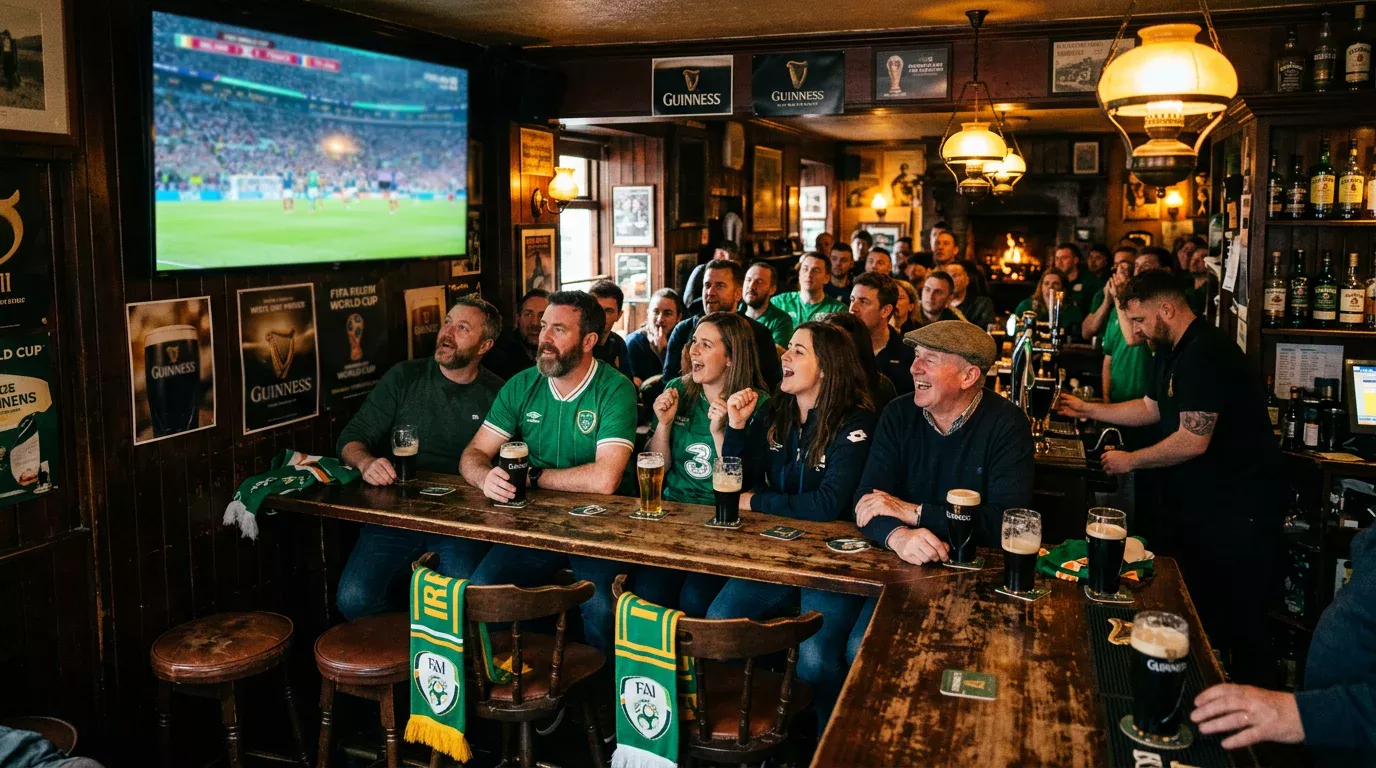
We’re not in it. We know that. You know that. Troy Parrott knows that better than anyone, having watched his penalty in Prague hit the net only for the fourth Irish kick to sail over the bar. The pain is real and it’s fresh — sixth World Cup in a row on the outside looking in, the longest drought since we first qualified in 1990. But the World Cup is still the World Cup, and I refuse to believe that 39 days of the best football on the planet can’t be enjoyed without a green jersey in the mix.
This guide is for every Irish fan who needs a plan. Not a tactical plan or a staking plan — I’ve covered those elsewhere — but a survival plan. Who do you adopt? When do you watch? Where do you watch? And how do you bet when you’ve got no emotional attachment to any of the 48 teams on the pitch? Being a neutral isn’t a curse. It’s a superpower, and I’m going to show you how to use it.
Adopt a Team — The Neutral’s Dilemma
The morning after the Prague penalty shootout, I woke up and realised I had a problem. For the first time since I started covering World Cups professionally, I had no horse in the race. No team to watch obsessively, no group stage fixtures circled in the calendar, no reason to care whether Thursday’s match in Houston kicks off at midnight or 2am. The World Cup without your own team is like Christmas dinner without the turkey — everything else is still there, but the centrepiece is missing.
So you adopt. Every Irish neutral at a World Cup adopts a team, whether they admit it or not. The question is which one, and the answer depends on what you’re looking for.
If you want the cultural connection, it’s Scotland. No debate. The Tartan Army are back at a World Cup for the first time since 1998, and the Celtic bond between Ireland and Scotland runs deeper than football. They’re in Group C with Brazil, Morocco, and Haiti — a brutally tough draw — and their chances of progressing beyond the group stage are slim. But that’s part of the appeal. Supporting Scotland at this World Cup will feel like supporting Ireland: underdogs, over-achievers on their day, and absolutely devastating when they inevitably concede a late equaliser. You’ll love every minute of it and hate the ending. It’s the Irish sporting experience, just in a darker shade of blue.
If you want the drama, it’s England. I know. I know. But hear me out. There’s nothing — absolutely nothing — in Irish sport that generates the range of emotions that watching England at a World Cup produces. If they win, you grudgingly acknowledge they deserved it and then find a way to diminish it within 24 hours. If they lose, you experience a joy so specific and so culturally conditioned that the Germans probably have a compound word for it. England are in Group L with Croatia, Ghana, and Panama. They’ll progress. They’ll probably reach the quarter-finals. And then they’ll lose in a way that produces enough pub-conversation material to last until the next tournament. Adopt England, but adopt them the way you adopt a telenovela — for the spectacle, not the outcome.
If you want pure football quality, adopt Spain. The reigning European champions play the most aesthetically pleasing football in the tournament. Lamine Yamal is 18 and already plays like a generational talent. Pedri controls midfield with the composure of a 30-year-old. Watching Spain at their best is like watching a masterclass, and for the neutral punter, their games are the easiest to read for in-play betting because their style is so consistent and predictable. Group H (Cape Verde, Saudi Arabia, Uruguay) is manageable, and their path to the semi-finals is clear.
If you want a story, adopt Haiti. The smallest nation in the tournament by population, the poorest by GDP, and the one with the most compelling narrative. Haiti qualified through CONCACAF and will be playing in their second-ever World Cup (after 1974). They won’t win. They probably won’t win a single match. But every minute they spend on the pitch at a World Cup is a triumph against odds that have nothing to do with football and everything to do with what this team represents for a nation that’s endured more hardship than most countries see in a century. Adopt Haiti for the group stage, and then switch to someone with a chance once they’re eliminated. It’s the emotionally responsible choice.
Viewing Guide — IST Kick-Off Times and Where to Watch
Here’s the brutal truth about the 2026 World Cup schedule for Irish fans: many of the best matches will kick off between midnight and 3am Irish Standard Time. The five-hour difference between IST and US Eastern Time means an 8pm kick-off in New York or Miami translates to 1am in Dublin. A 9pm kick-off on the West Coast — matches in Seattle, Los Angeles, or San Francisco — pushes to 2am or later.
The group stage offers some mercy. Matches in Mexico (Estadio Azteca, Guadalajara, Monterrey) kick off at local times that are six hours behind Ireland, meaning a 4pm local kick-off in Mexico City is 11pm IST — late but manageable. Matches at Eastern US venues (MetLife, Hard Rock, Lincoln Financial Field, Gillette) at 1pm local time translate to 6pm IST, which is perfect for a post-work pint and a match. The scheduling gods will determine which specific matches get which time slots, but you can expect the marquee group stage fixtures — Brazil vs Morocco, England vs Croatia, France vs Senegal — to be given prime-time US slots, which means late-night viewing in Ireland.
The knockout rounds and the final will all be evening events in the US, which means the 1am-3am IST window will be your home for the business end of the tournament. The final at MetLife Stadium on 19 July will likely kick off at 4pm ET, which is 9pm IST — the one concession to the European television audience. That’s a Saturday night in July. Plan accordingly.
For where to watch, every pub in Ireland with a television license will be showing World Cup matches. RTE hold the Irish broadcast rights and will cover every match either live or on delay. For the late-night matches, your best option is a pub with an extended license, a mate’s gaff with a projector, or the quiet dignity of your own sofa with a cup of tea and a blanket. The atmosphere won’t match being in the stadium, but the commentary will be in an accent you understand, and nobody will spill beer on your shoes.
The World Cup Pub Experience Without Your Own Team
I watched the 2022 World Cup final in a pub in Ranelagh. Argentina vs France. The place was packed, but there was a strange energy — nobody had a real stake in it. A few lads in Messi jerseys they’d bought on Amazon. A couple of French students from Trinity. And about 40 Irish people who were there because it was the World Cup final and where else would you be?
That’s the neutral pub experience, and it’s genuinely brilliant once you embrace it. You’re free. You can cheer for both teams. You can switch allegiance at half-time based on who’s playing better football. You can boo a dive regardless of who committed it. You can celebrate a goal purely because it was a beautiful goal, without the crushing context of what it means for your team’s tournament. The neutral in the pub is the most liberated person in the room.
The trick is finding the right pub. For the 2026 World Cup, you want somewhere that’s showing matches consistently, not just the semi-finals and final. You want a place that’ll have the early group stage matches on — even the 11pm Tuesday night ones — because those are where the stories begin. Ask around in early June. The pubs that commit to showing every match (or at least the IST-friendly ones) will become the unofficial World Cup headquarters for your area, and the community that builds around regular viewing is half the enjoyment.
One cultural note: Irish pub etiquette during World Cup matches involving England is its own art form. If England are winning, the room splits between genuine neutrals who admire good football and everyone else, who are waiting for the inevitable collapse. If England are losing, the atmosphere becomes euphoric in a way that has nothing to do with whoever’s beating them. If England go out on penalties, the pub erupts with the kind of energy usually reserved for an All-Ireland final winner. It’s not personal. It’s historical. And it’s one of the great unwritten rituals of Irish sporting culture.
Betting as a Neutral — The Freedom of No Loyalty
Here’s the genuine advantage of Irish fans at the World Cup 2026: we can bet with our heads, not our hearts. When your team is in the tournament, every betting decision is contaminated by emotional bias. You overrate your own squad. You underrate the opposition. You back your team to win the group because the alternative — admitting they might not — feels like betrayal. That bias costs money. Studies of betting patterns at major tournaments consistently show that fans of participating nations place less profitable bets than neutrals, primarily because they overestimate their own team’s chances.
As Irish neutrals, we have none of that. I can look at the outright winner market with zero attachment and conclude that France at 5/1 are better value than Brazil at 9/2, without any voice in my head screaming about loyalty. I can assess England’s quarter-final chances dispassionately — admitting they have a 40% chance of beating Spain — without needing them to lose for my own emotional satisfaction. The freedom is liberating, and if you channel it properly, it makes you a better punter.
My advice for neutral betting at this World Cup: build a portfolio of five to ten pre-tournament bets spread across outright winner, top scorer, group winner, and two or three specific match propositions. Treat it as a financial investment rather than an emotional one. Stake evenly. Don’t chase losses. And most importantly, don’t adopt a team for betting purposes — keep your adopted team for emotional support and your bets for cold analysis. If you’ve decided to cheer for Scotland, don’t back Scotland to qualify from Group C just because you want them to. Back them only if the odds represent value. The teams overview has the full breakdown of every squad if you need to separate sentiment from analysis.
The Storylines to Follow — From Scotland’s Return to the Debutants
Every World Cup is defined by its narratives, and the 2026 tournament offers more compelling storylines than any in recent memory. Here’s what I’ll be following from my sofa in Dublin.
Scotland’s return after 28 years is the storyline closest to Irish hearts. The Tartan Army haven’t been at a World Cup since France 1998, when they lost all three group matches and went home with the immortal Craig Brown line about “moral victories.” This time, they’re in Group C with Brazil and Morocco — a draw that makes 1998 look gentle. But Scotland have improved dramatically, and a single result — a draw against Morocco, a point against Brazil — would be treated as a historic achievement. Watch the Scotland matches. Cheer loudly. And if they somehow scrape into the knockout rounds as one of the best third-placed teams, clear your schedule.
The four debutant nations — Cape Verde, Curaçao, Jordan, and Uzbekistan — each bring a story worth following. Cape Verde, a volcanic archipelago with a population of 600,000, qualified through CAF and are the smallest nation to reach a World Cup since Trinidad and Tobago in 2006. Curaçao, a Caribbean island of 150,000 people, qualified through CONCACAF. Jordan’s qualification was their first in any major tournament. Uzbekistan emerged from the ultra-competitive AFC qualifying process. None are expected to progress beyond the group stage, but World Cup debuts produce moments — Senegal beating France in 2002, Costa Rica reaching the quarter-finals in 2014 — that transcend expectations.
Messi’s farewell (probably) is the individual storyline that will dominate the tournament’s narrative arc. If this is Lionel Messi’s last World Cup — and at 39, it almost certainly is — every Argentina match becomes a potential final chapter. Whether he starts, comes off the bench, or plays a reduced role, the world will be watching. From a neutral’s perspective, there’s a particular pleasure in watching a genius at work without the anguish of hoping he doesn’t score against your team.
The USA as hosts present a fascinating cultural storyline for Irish viewers. American sports culture is built around entertainment value, and the World Cup infrastructure — from the massive NFL stadiums to the broadcast production — will be unlike anything we’ve seen at a football tournament. The question of whether the USA can convert their investment in hosting into a genuine run in the tournament is one that Irish fans, having watched our own sporting infrastructure develop over decades, can appreciate.
And finally, the Iran situation adds an unprecedented geopolitical layer. Iran’s participation remains uncertain due to the military conflict, with FIFA’s congress on 30 April expected to provide a resolution. If Iran withdraw or are excluded, Group G will be restructured, and the ripple effects will touch every bracket prediction and outright market in the tournament. It’s not a storyline anyone wants, but it’s one that every informed neutral needs to follow.