
BMO Field — World Cup 2026 Venue in Toronto
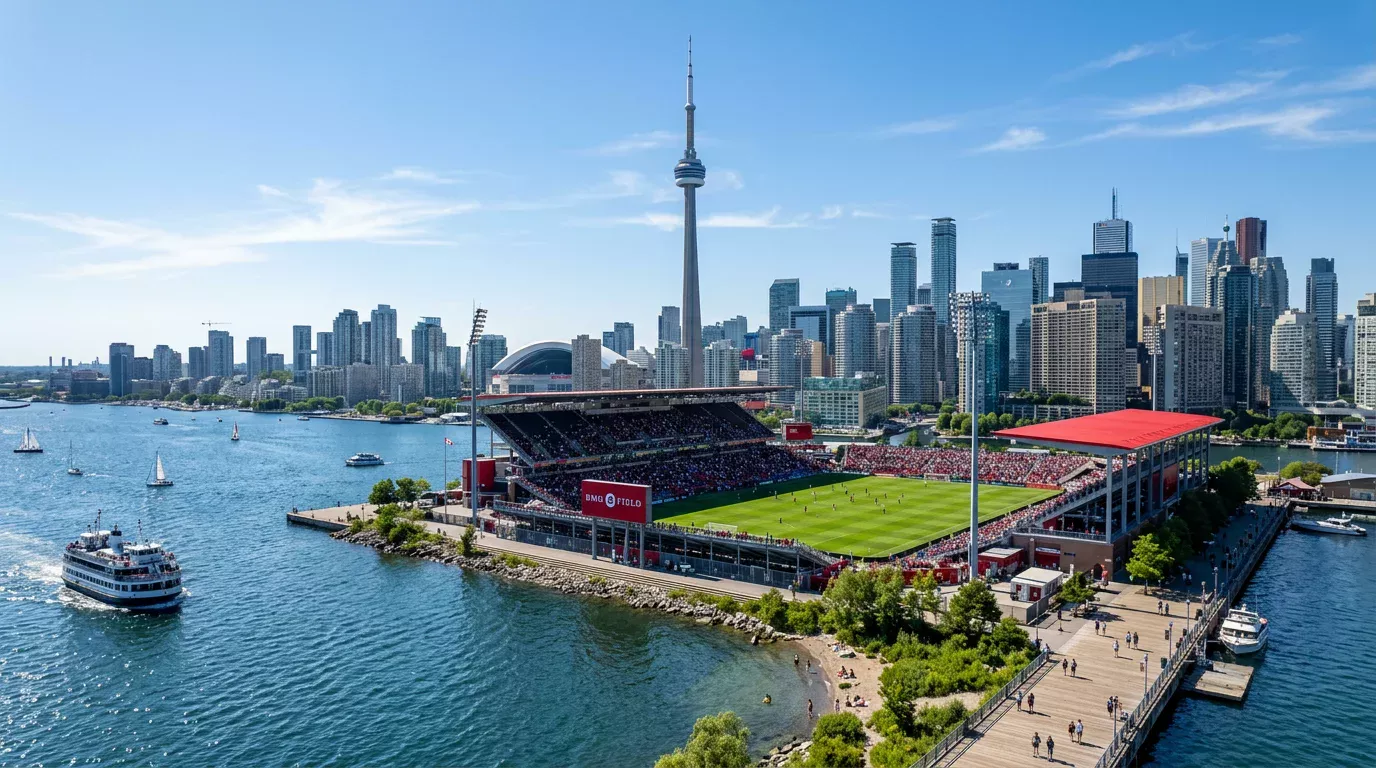
I spent a week in Toronto covering a Gold Cup fixture a few years back, and the thing that struck me most was how the city felt like a version of London that actually worked. Efficient public transport, walkable neighbourhoods, a food scene that rivals any European capital, and a multicultural population that meant every football match — regardless of who was playing — drew a crowd that genuinely cared. BMO Field sits at the southern edge of the city, on the shores of Lake Ontario, and when Canada host their World Cup 2026 group matches here, the atmosphere will be unlike anything Canadian football has experienced. This is a country that only qualified for its second-ever World Cup in 2022, and now it is hosting one. BMO Field is where that story comes to life.
About BMO Field
BMO Field opened in 2007 as a football-specific stadium — the first of its kind in Canada — and serves as the home of Toronto FC in MLS and the Canadian national teams. The original capacity of 20,000 has been expanded through multiple renovations, and for the 2026 World Cup, temporary structures will increase the total to approximately 45,000. That makes BMO Field the smallest venue at the tournament, but what it lacks in scale it compensates for in intimacy and atmosphere. The compact design creates a cauldron effect — every seat is close to the pitch, and the noise generated by even a partial crowd is disproportionate to the venue’s size.
The stadium is situated in Exhibition Place, a 79-hectare parkland on Toronto’s waterfront. The Lake Ontario location provides natural cooling breezes during the summer months, and the June-July climate in Toronto is comfortable by North American standards — average highs of 25-27 degrees Celsius with moderate humidity. These are conditions that European teams will find familiar, more akin to a warm London or Paris summer day than the oppressive heat of Miami or Houston. For punters, the climate factor at BMO Field is essentially neutral — no team gains a significant environmental advantage.
The pitch surface will be natural grass, installed to FIFA’s specifications of 105 by 68 metres. BMO Field has experience hosting international football — it was a venue for the 2007 FIFA U-20 World Cup and has hosted numerous CONCACAF Gold Cup and Nations League matches — so the operational infrastructure for major football events is already well-established. The broadcast facilities and media areas are being upgraded for the World Cup, but the core stadium experience is proven and reliable.
World Cup 2026 Matches at BMO Field
BMO Field will host group-stage matches during the 2026 World Cup, with Canada’s Group B fixtures expected to be the headline attractions. FIFA has not confirmed the exact match allocations, but the probability of Canada playing at least one — and possibly two — of their group matches at BMO Field is high. The atmosphere for a Canadian World Cup match in Toronto will be extraordinary: a packed house, a national team playing on home soil at a World Cup for the first time, and the emotional weight of a country that has embraced football more passionately in the last five years than in the previous fifty.
The smaller capacity means ticket demand for BMO Field matches will be intense. With approximately 45,000 seats available — compared to 82,000 at MetLife or 70,000 at SoFi — BMO Field will be one of the hardest tickets at the entire tournament. For Irish fans hoping to attend matches in Toronto, early application through the FIFA ticketing portal is essential. Hospitality packages may offer an alternative route for those willing to pay a premium.
For Irish viewers watching from home, BMO Field matches will kick off at manageable IST times. Toronto operates on Eastern Time, five hours behind IST during the summer. An evening kick-off at 7pm ET translates to midnight IST — late enough to require commitment but early enough to avoid the 2-3am starts that west coast venues impose. The time zone, combined with the temperate climate, makes BMO Field one of the most viewer-friendly venues at the tournament for European audiences.
Toronto — What to Know
Toronto is Canada’s largest city and one of the most multicultural metropolitan areas on earth. Over half of the city’s population was born outside Canada, and more than 200 languages are spoken across its neighbourhoods. For World Cup visitors, this diversity translates into a food scene that spans every continent, cultural festivals that overlap with the tournament dates, and a welcoming attitude towards international visitors that reflects the city’s identity. The Kensington Market, Chinatown, Little Italy, and Greektown districts each offer a different culinary and cultural experience within walking distance of the city centre.
BMO Field is easily accessible by public transport. The TTC streetcar system runs to Exhibition Place, and the GO Transit commuter rail network connects suburban areas to Union Station in downtown Toronto, from where the streetcar journey to the stadium takes roughly 15 minutes. The Billy Bishop Toronto City Airport — a small airport on the Toronto Islands — is within walking distance of the stadium and serves domestic and some US flights, though most international visitors will arrive at Toronto Pearson International Airport (YYZ), located approximately 30 kilometres northwest of the city centre.
For Irish fans, Toronto feels familiar in ways that other North American cities do not. The pub culture is real, the humour is dry, and the sense of community in neighbourhoods like The Junction and Leslieville mirrors the best of Dublin’s suburban villages. The Irish community in Toronto is significant — St Patrick’s Day is a major event, and Irish pubs are scattered across the city. Finding a place to watch the football with people who understand what a World Cup means to a small footballing nation will not be a challenge.
Stadium History and Significance
BMO Field’s history is the history of Canadian football’s modern era. When it opened in 2007, Toronto FC was one of only two Canadian teams in MLS, and the national team’s programme was an afterthought in a country dominated by ice hockey. The stadium became the catalyst for change — a purpose-built football venue that signalled Canada was serious about the sport. The expansion of the stadium, the growth of MLS in Canada, and the country’s successful bid to co-host the 2026 World Cup are all connected to the foundation that BMO Field helped establish.
For the 2026 World Cup, BMO Field represents something more than infrastructure. It is the venue where Canadian football announces itself to the world — where a country that has spent decades building towards this moment finally steps onto the stage. The intimacy of the stadium, the proximity of the crowd to the pitch, and the raw emotion of a home World Cup will combine to create an atmosphere that larger venues simply cannot replicate. If there is one ground at this tournament where the crowd truly becomes the twelfth man, it will be BMO Field.
Getting There From Ireland
Direct flights from Dublin to Toronto Pearson International Airport (YYZ) operate regularly, with a flight time of approximately seven and a half hours. Toronto Pearson is located 30 kilometres from downtown Toronto, with the UP Express train providing a 25-minute direct connection to Union Station. From Union Station, the TTC streetcar to BMO Field takes roughly 15 minutes. Irish citizens require a valid eTA (Electronic Travel Authorization) to enter Canada — this is Canada’s equivalent of the US ESTA and should be applied for online before departure. Processing is typically fast, but applying at least two weeks before travel is recommended.
Accommodation in Toronto ranges from luxury hotels in the Financial District and Yorkville to mid-range options in neighbourhoods like Queen West, Parkdale, and the Annex. For proximity to BMO Field, Liberty Village and King West are the best bets — both are within walking distance of the stadium and offer a range of restaurants, bars, and entertainment. Toronto is not a cheap city, but it is more affordable than New York or Los Angeles, and the Euro-to-Canadian Dollar exchange rate currently favours European visitors.
For the complete World Cup 2026 match schedule in Irish time, including BMO Field fixtures, visit our dedicated schedule page.