
Value Betting at the World Cup 2026 — Finding Odds the Bookies Got Wrong
 Available in US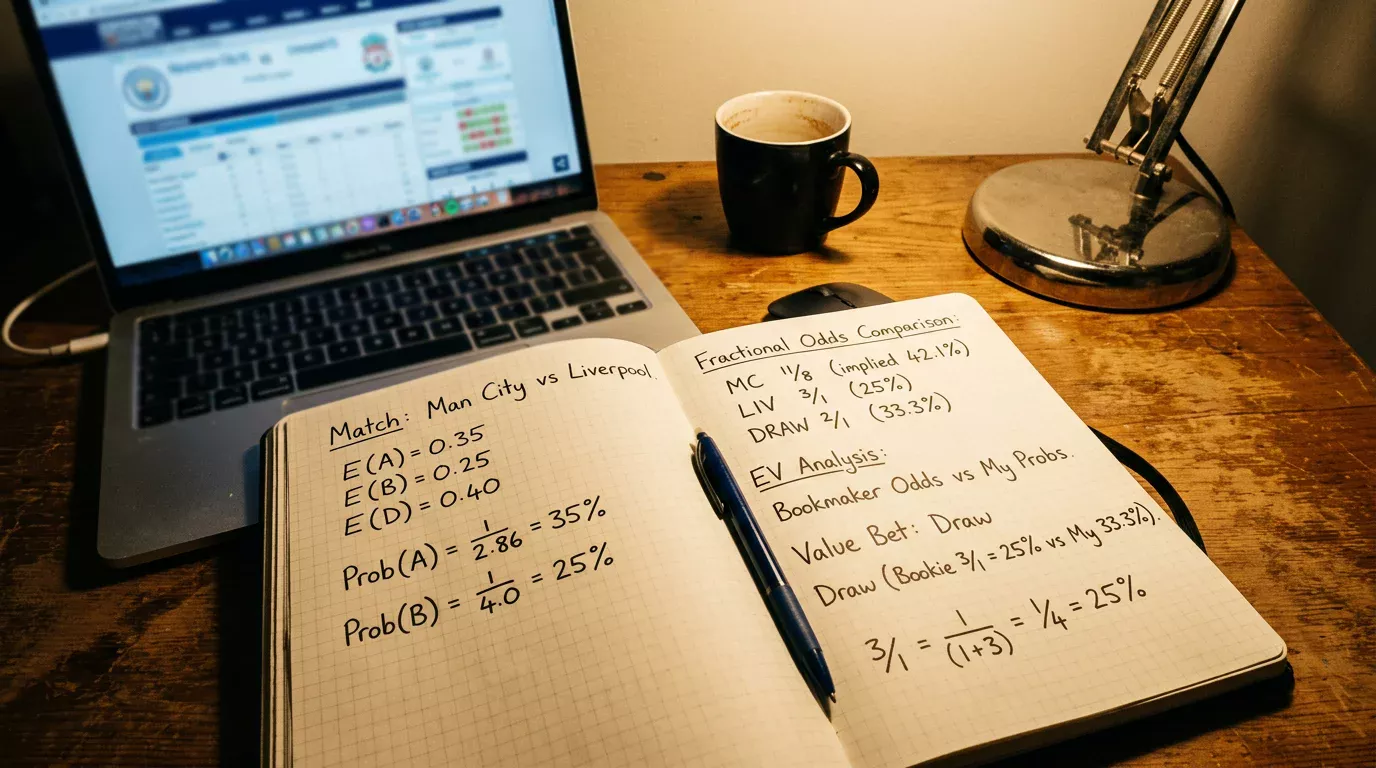
Most punters don’t lose because they pick the wrong team. They lose because they take the wrong price. I watched a mate back Argentina to beat Saudi Arabia at the 2022 World Cup at 1/8. Argentina lost 2-1. He was stunned. But the real mistake wasn’t picking Argentina — it was accepting 1/8 in a match where the true probability of an Argentine win was closer to 80%, not the 89% that 1/8 implies. There’s a gap between the bookmaker’s price and reality, and when that gap works against you, even correct analysis leads to unprofitable betting.
Value betting flips that equation. Instead of asking “who will win this match?” it asks “is the price the bookmaker is offering better than the true probability of the outcome?” If the answer is yes, you bet. If the answer is no, you don’t — regardless of how confident you are in the result. It’s a discipline, not a strategy, and at a World Cup with 104 matches and hundreds of markets, the opportunities for finding world cup value betting are more abundant than at any other tournament.
What Makes a Bet a Value Bet?
Imagine I flip a coin and offer you 3/1 on heads. The true probability of heads is 50%, which means fair odds would be evens (1/1). At 3/1, the implied probability is 25% — but the real probability is 50%. You’re getting double the return that the true odds justify. That’s value. You should take that bet every single time, even though you’ll lose it half the time, because over a large enough sample, the excess return compounds into profit.
Transfer that logic to football. A bookmaker prices Morocco to beat Brazil in their Group C opener at 7/1. That implies a 12.5% chance of a Moroccan win. But you assess — based on Morocco’s 2022 World Cup semi-final run, their defensive record, their squad strength, and the specific matchup — that Morocco have a 20% chance of winning. The true odds should be 4/1. At 7/1, the bookmaker is offering you nearly double the fair price. That’s a value bet, even though Morocco are more likely to lose than win.
The critical mindset shift is separating “value” from “likely to win.” A value bet doesn’t have to be a winning bet. It has to be a bet where the odds are in your favour over the long run. If you consistently identify situations where the bookmaker’s implied probability is lower than the true probability, you’ll be profitable across a portfolio of bets — even if individual bets within that portfolio lose. This is how professional bettors operate. They don’t celebrate wins or lament losses. They track whether their assessments were more accurate than the market’s, and they trust the maths.
Why World Cups Are a Goldmine for Value
The Premier League is one of the most efficient betting markets in the world. Bookmakers have decades of data, sophisticated models, and enormous betting volume that corrects any mispricing within minutes. Finding value in a Liverpool vs Chelsea match is genuinely difficult because thousands of sharp bettors are analysing the same match with the same data.
The World Cup is different. The expanded 48-team format means bookmakers are pricing matches involving teams they have limited data on. How many matches has Curaçao played against top-50 opposition in the last two years? How should bookmakers price Uzbekistan’s first-ever World Cup match? What’s the correct implied probability for Cape Verde to take a point off Spain? These are questions where the bookmakers’ models are working with thin data, and thin data produces imprecise odds.
The debutants and lower-ranked teams are where the widest value gaps tend to appear. Bookmakers systematically overprice favourites in matches against unfamiliar opponents because they default to name recognition and FIFA ranking rather than recent form and tactical analysis. At the 2022 World Cup, Saudi Arabia were priced at 13/1 to beat Argentina. Morocco were 4/1 to beat Belgium. Japan were 7/1 to beat Germany. All three won. In each case, the bookmaker’s price implied a probability significantly lower than the actual chance of an upset.
The group stage is the richest hunting ground because you have 48 matches in the first two weeks alone, many involving unfamiliar matchups. By the time the knockout rounds begin, the market has corrected — bookmakers have seen every team play at least twice and adjusted their models accordingly. The first matchday of the group stage, when everything is projection and nothing is confirmed, is the single best day for value betting at the entire tournament.
Our Top Value Picks for 2026
I’ll be specific because vague value picks are useless. Here are five areas where I believe the market is mispriced heading into the 2026 World Cup.
Morocco to finish top of Group C, currently priced around 9/2. This group contains Brazil, Morocco, Haiti, and Scotland. The market assumes Brazil top the group, but Morocco beat Belgium and Spain at the 2022 World Cup and have only gotten stronger. Brazil’s record against defensively disciplined African sides is poor — they drew 0-0 with Morocco at the 2018 tournament (in a friendly, admittedly, but the tactical pattern holds). If Morocco beat Brazil in the group opener and then handle Haiti and Scotland, they top the group. At 9/2, I think the true probability is closer to 25-30%, which would make fair odds around 3/1. There’s value here.
Turkey to qualify from Group D, available at approximately 3/1 in the “to qualify” market. Turkey beat Kosovo 1-0 in the UEFA playoff to reach the tournament, and they’re a physical, well-organised team that’s difficult to beat. Group D features the USA, Paraguay, and Australia alongside Turkey. Qualification requires finishing in the top two or as one of the best third-placed teams. I give Turkey about a 45-50% chance of qualifying, which implies fair odds of around evens to 6/5. At 3/1, the market is underrating them significantly.
Draw in England vs Croatia (Group L), currently priced near 12/5. These two sides met in the 2018 World Cup semi-final, which Croatia won in extra time after it was 1-1 at full time. They met again in the Euro 2020 group stage, which England won 1-0. Matches between England and Croatia are consistently tight, low-scoring, and cautious. A draw in their 2026 group stage meeting is more likely than the 12/5 price suggests — I’d put the true probability at around 30%, which implies fair odds of 7/3. The margin is small, but it’s there.
Under 2.5 goals in at least four of the six Round of 32 matches involving group winners vs third-placed teams. This is a tournament-level value play based on the structural incentive. Third-placed teams that qualify will play defensively to protect their position, and group winners will be cautious against unknown opponents in an unfamiliar knockout format. The first Round of 32 matches are likely to be cagey, tactical affairs — think 1-0 and 2-1 scorelines rather than 3-2 and 4-1. Look for bookmakers offering a “number of matches under 2.5 goals in the Round of 32” market and take the over.
Scotland to pick up at least 3 points in Group C, typically offered around 8/11. Scotland face Brazil, Morocco, and Haiti. A win against Haiti (which I’d rate at roughly 55-60% probability) and a draw against either Brazil or Morocco (maybe 20-25% each) gives them a realistic path to three or more points. The 8/11 price implies a probability of about 58%, but my assessment puts it closer to 65-70%. It’s not a massive edge, but across a portfolio of value bets, these small margins accumulate.
How to Spot Value — A Practical Checklist
Finding value isn’t magic. It’s a process. Here’s the checklist I use before placing any bet at a major tournament.
First, assess the true probability. Before looking at the bookmaker’s odds, form your own view of the likely outcome. Use whatever inputs you trust: Elo ratings, recent form, head-to-head records, tactical analysis, squad depth. Write down a percentage. “I think Morocco have a 25% chance of beating Brazil.” Only after you’ve committed to your assessment do you check the bookmaker’s price.
Second, convert the bookmaker’s odds to implied probability. Fractional odds of 7/1 imply a 12.5% probability (1 divided by 8). Decimal odds of 4.00 imply a 25% probability (1 divided by 4). If the bookmaker’s implied probability is lower than your assessed probability, there’s potential value. If it’s higher, walk away.
Third, check the margin. Bookmakers build a margin (also called the overround or vig) into every market. In a two-outcome market with true 50/50 odds, a bookmaker might offer 10/11 on each side rather than evens — the total implied probability is 52.4% rather than 100%, and the extra 2.4% is the bookmaker’s profit. In a three-way World Cup match market (home/draw/away), the margin is typically 5-8%. Your value edge needs to exceed the margin to be genuinely profitable. A 2% edge in a market with a 6% margin is a 2% edge before the margin, which means you’re actually losing 4%.
Fourth, consider the sample size. Value betting works over large numbers of bets, not on individual wagers. If you identify ten value bets across the group stage, your portfolio should be profitable even if four or five of them lose. If you identify one value bet and stake your entire budget on it, you’re gambling, not value betting. The distinction matters.
When “Value” Is Just Wishful Thinking
The most dangerous trap in value betting is confusing a price you’d like to take with a price that’s genuinely mispriced. Every punter has biases, and those biases contaminate probability assessments in predictable ways.
Confirmation bias is the biggest offender. You fancy Colombia to do well at the World Cup. You read an article about their Copa América run. You watch a highlight reel of their best goals. By the time you assess their probability of qualifying from Group K, you’ve convinced yourself they’re a 70% chance when a dispassionate analysis would put them at 55%. The odds look like value because your probability assessment is inflated by your emotional preference.
Recency bias is the second trap. Morocco reached the 2022 semi-finals, so you rate them highly for 2026. But the squad has changed. The manager may have changed. The group opponents are different. Rating Morocco in 2026 based on their 2022 run is like rating a horse based on last season’s form without checking if it’s carrying a different jockey and ten extra pounds. Recent results are one input, not the only input.
The antidote to both biases is to use a structured model rather than gut feel. Assign weights to different factors — Elo rating (30%), recent form (25%), squad depth (20%), group draw difficulty (15%), home/away/neutral advantage (10%) — and calculate your probability mechanically. The result might not match your instinct, and that’s the point. When your gut says 65% and your model says 50%, trust the model. Save your gut for deciding what to have for dinner, not for assessing the probability of Turkey beating the USA. If you want to see how these probability assessments translate into actual outright prices, the winner odds page has the latest numbers from the major Irish bookmakers.
