
World Cup 2026 Winner Odds — Who’s the Punters’ Favourite?
 Available in US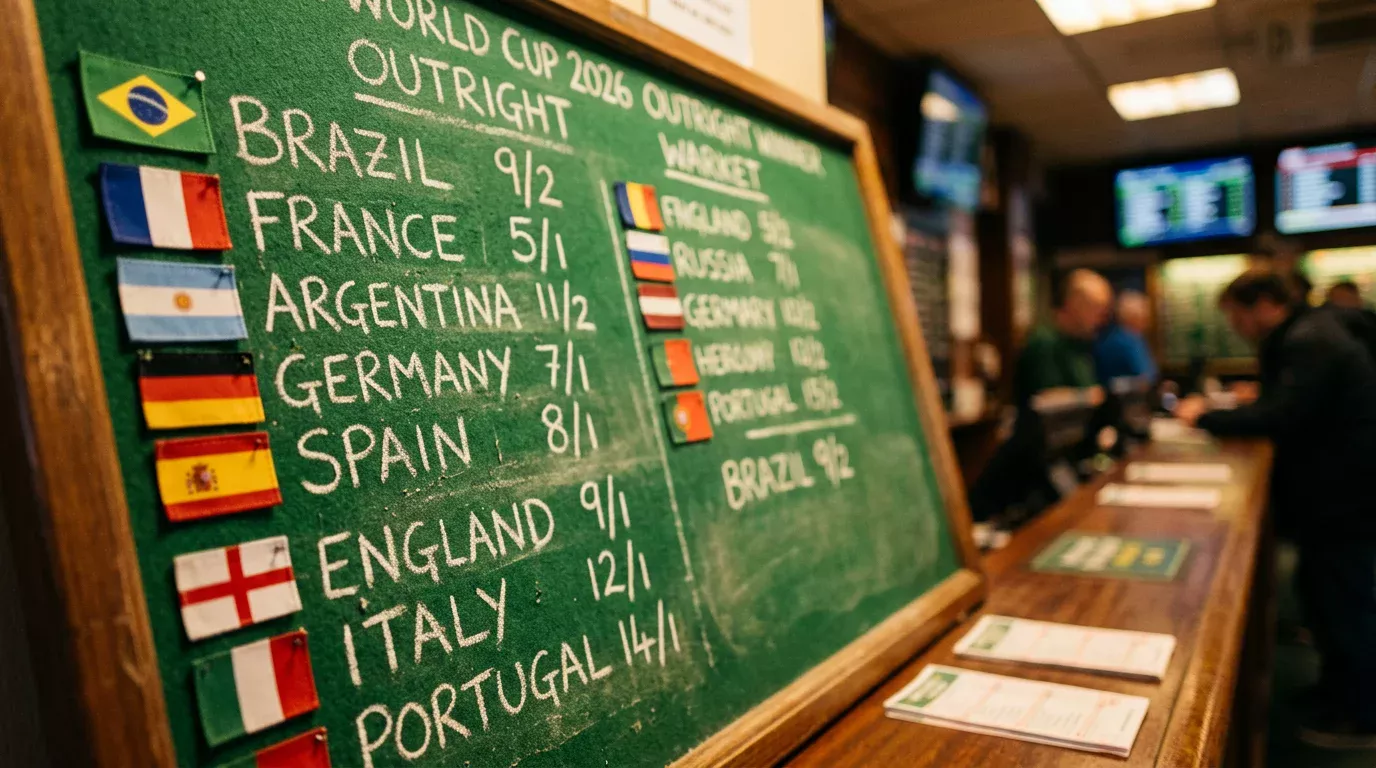
Three mates in a Dublin pub, four different answers to the same question: who wins the World Cup? One says Brazil because it’s always Brazil. Another says France because they’ve got the squad depth to grind through seven knockout rounds. The third picks Argentina because you don’t bet against defending champions. And the fourth — the one who’s actually looked at the World Cup 2026 winner odds — says something none of them expected.
That’s the beauty of outright betting. The market doesn’t care about your loyalty, your gut feeling, or who your da thinks is due a trophy. It prices probability. And right now, with 48 teams heading to North America this June, those prices tell a story worth reading before you part with a single euro.
I’ve spent the last nine years tracking how outright odds shift across major tournaments, and one pattern holds: the market at this stage — two months before kick-off — is the most generous it’ll ever be. Once the group stage starts, the value dries up faster than a pint at a stag do. So let’s look at where the smart money sits in April 2026.
Current Outright Winner Odds — April 2026
I pulled odds from four major bookmakers licensed to operate in Ireland this week, and the picture is remarkably consistent across the board. The top of the market has barely moved since the draw in December, which tells me the bookmakers are confident in their assessments — and that’s either a sign they’ve got it right, or that they’re all copying each other’s homework.
Brazil sit at the top of most lists at around 9/2, which translates to a 5.50 decimal price and an implied probability of roughly 18%. France are close behind at 5/1 (6.00 decimal, about 17%), followed by Argentina at 11/2 (6.50, around 15%). England and Spain round out the top five, both hovering near the 7/1 mark depending on which book you check.
Germany, who many casual fans still assume belong in the top tier, have drifted to 10/1 across most markets. That’s a meaningful gap from the top three and reflects two consecutive tournaments where they failed to get out of the group stage — 2018 and 2022 — plus a quarter-final exit on home soil at Euro 2024. The market remembers.
The host nations tell an interesting story. The USA are priced at approximately 14/1, which is shorter than you might expect for a team ranked outside the world’s top ten. Home advantage is being priced in aggressively — I’d estimate it accounts for two or three points on their odds. Mexico sit around 33/1, while Canada, the weakest of the three co-hosts, are out near 80/1.
Portugal at 8/1 and the Netherlands at 12/1 occupy that awkward middle ground between genuine contenders and dark horses. Both have the talent to win the tournament but enough question marks to keep them below the favourites. Below them, you’ll find teams like Colombia (25/1), Uruguay (28/1), and Morocco (33/1) offering significantly longer prices for those willing to take a swing.
At the bottom of the market, the four debutants — Cape Verde, Curaçao, Jordan, and Uzbekistan — are all priced at 500/1 or higher. That’s the bookmakers politely saying “not happening” without actually refusing to take your money.
Breaking Down the Top Five Favourites
Numbers on a screen mean nothing without context. Let me walk through why each of the five shortest-priced teams sits where it does — and whether I think the market has it right.
Brazil at 9/2 makes sense on paper. Five World Cup titles, a squad packed with attacking talent playing at Europe’s biggest clubs, and a draw that puts them in Group C alongside Morocco, Haiti, and Scotland. They should cruise through the group stage, which gives them momentum heading into the Round of 32. The concern? Brazil haven’t won a World Cup since 2002. That’s 24 years of underperformance relative to expectations, and the weight of that drought is real. Their quarter-final exit in 2022 — on penalties against Croatia — was the latest chapter in a pattern of tournament collapses. At 9/2, I think the market is pricing the name on the jersey as much as the team wearing it.
France at 5/1 are interesting because this is a squad in transition. The core that won in 2018 and reached the final in 2022 is ageing. Hugo Lloris is long retired, Olivier Giroud likewise, and while Kylian Mbappé remains the centrepiece, the supporting cast around him has changed significantly. Aurélien Tchouaméni and Eduardo Camavinga anchor the midfield now, and both are elite. France’s depth is arguably the best in the tournament — they could field two separate squads that would each be top-ten sides. Group I (Senegal, Norway, Iraq) won’t trouble them. At 5/1, I think France represent fair value, neither overpriced nor underpriced.
Argentina at 11/2 carry the weight of being defending champions. Lionel Messi will be 39 by the time the final rolls around on 19 July, and while he’s indicated he intends to be in the squad, his role will be limited compared to Qatar. Lionel Scaloni has built a system that doesn’t depend on any single player, and the depth of Argentine talent in European leagues is extraordinary. Julián Álvarez, Enzo Fernández, Alexis Mac Allister — this is a squad that can compete at the highest level with or without Messi on the pitch. Group J (Algeria, Austria, Jordan) is manageable. At 11/2, I think Argentina are slightly undervalued. Defending champions have won back-to-back titles twice in World Cup history (Italy in 1934-38, Brazil in 1958-62), and while it’s rare, this squad has the quality to do it.
England at 7/1 — and here’s where I have to declare an interest as someone covering this tournament for an Irish audience. We’ll be watching England more than any other team, partly because they’re next door and partly because there’s nothing quite like watching them get knocked out in a penalty shootout. But setting aside the schadenfreude, this England squad is genuinely good. The Golden Generation talk that plagued them in the 2000s doesn’t apply here because this group has already reached a Euro final (2020) and a World Cup semi-final (2018). Group L pairs them with Croatia, Ghana, and Panama — a draw they’ll be satisfied with. At 7/1, I think England are about right. They have the squad to win it, but whether they have the tournament mentality is the eternal question.
Spain at 7/1 are the reigning European champions, having won Euro 2024 in Germany with one of the most exciting young squads in recent memory. Lamine Yamal, Pedri, Gavi, Nico Williams — this is a team built for the next decade. Their group (H: Cape Verde, Saudi Arabia, Uruguay) has one serious test in Uruguay, but nothing they can’t handle. Spain’s concern is the same one that’s dogged them since 2010: they dominate possession but can struggle against deep-sitting defensive teams in knockout football. At 7/1, alongside England, I think they’re marginally better value because the Euro 2024 triumph proves this specific group of players can win a major tournament.
Value Bets — Where the Smart Money Goes
Every punter wants to back the winner at 5/1. But in my experience, the real profits at a World Cup come from identifying teams priced longer than they should be. The bookmakers are very good at pricing the top five, where there’s enormous betting volume and constant market correction. They’re less precise further down the list, and that’s where value hides.
Portugal at 8/1 are my first value pick. They topped Ireland’s qualifying group comfortably, they have a squad that blends experience (Bernardo Silva, Bruno Fernandes) with emerging talent, and their Group K draw (DR Congo, Uzbekistan, Colombia) is one they’ll navigate without breaking a sweat. The question around Cristiano Ronaldo — will he be in the squad, will he start, will he accept a reduced role — is a distraction that artificially inflates their price. Portugal are a semi-final-calibre team regardless of what Ronaldo does. At 8/1, there’s a point or two of value there.
The Netherlands at 12/1 are another team I think the market underestimates. They reached the World Cup quarter-finals in 2022 and have a system under their current setup that prioritises defensive solidity — unusual for a Dutch side, but effective. Group F (Japan, Sweden, Tunisia) is tricky but winnable. If they emerge from the group with three clean sheets, which is entirely possible, that defensive foundation could carry them deep into the knockout rounds. At 12/1, I’d have them closer to 10/1.
Colombia at 25/1 are the long-shot value play. They’re in outstanding form, their squad features players excelling at the top level of club football, and they’ve historically performed well in World Cups held in the Americas. Group K alongside Portugal is a challenge, but second place is very achievable, and from there, the draw could open up favourably. Twenty-five to one for a team capable of reaching the quarter-finals — and potentially going further on their day — is a price I’d happily take a small stake on.
Morocco at 33/1 deserve a mention. Their run to the 2022 semi-finals was dismissed by many as a fluke, but the underlying performances were genuine. They beat Belgium, Spain, and Portugal in Qatar. The squad has only gotten stronger since. Group C (Brazil, Haiti, Scotland) means a tough opener, but second place — and a spot in the Round of 32 — is well within reach. At 33/1, you’re getting a semi-finalist from four years ago at a price that suggests they’ll be knocked out in the group stage. That doesn’t add up.
Do Host Nations Get a Boost? — USA, Mexico, Canada Odds
South Korea reached the semi-finals in 2002 when they co-hosted. Russia made the quarter-finals in 2018 on home soil, despite being the lowest-ranked team in the tournament. South Africa, the only host nation to be eliminated in the group stage (2010), were also the only host at the time to have never previously qualified for a World Cup through the standard route. The data is clear: hosting gives you a measurable advantage.
The USA at 14/1 are the primary beneficiary this time around. They’ll play the majority of their matches in front of sold-out American crowds, in familiar climatic conditions, with zero travel fatigue. Group D (Paraguay, Australia, Turkey) is kind. The Round of 32 is achievable for even a moderately competent US side, and once you’re in the knockouts, anything can happen over 90 minutes. I think 14/1 is about right — it factors in the home advantage without overestimating the squad’s quality relative to the traditional powerhouses.
Mexico at 33/1 host the opening match against South Africa at Estadio Azteca on 11 June. The atmosphere in Mexico City will be extraordinary, and the emotional lift of that occasion shouldn’t be underestimated. Mexico have a strong tournament pedigree — they’ve reached the Round of 16 at seven consecutive World Cups — but consistently fail to progress beyond that point. Their World Cup 2026 winner odds reflect a team that will entertain, qualify from the group, and probably bow out in the first or second knockout round. At 33/1, I’d leave them alone unless you’re betting with your heart rather than your head.
Canada at 80/1 are the weakest of the three hosts. Their 2022 World Cup campaign in Qatar — their first since 1986 — ended without a single point. The squad has improved since, and Alphonso Davies remains a world-class talent, but the depth simply isn’t there to compete with the tournament’s elite. Group B (Bosnia and Herzegovina, Qatar, Switzerland) is tough but not impossible. At 80/1, Canada are a punt for the romantics. I wouldn’t touch it.
The Neutral’s Pick — Who Should Irish Fans Back?
Right, let’s address the elephant in the room. Ireland aren’t going. We know. We’ve known since that penalty miss in Prague, and we’ve had months to process it. Sixth World Cup in a row we’re watching from the sofa, and at this point, the sofa has a permanent imprint. But here’s the silver lining: being a neutral at a World Cup is the best position for a punter. No emotional attachment, no bias, no “I’m backing them because they’re ours.” Pure cold analysis.
If I’m picking one team for the average Irish punter to follow — and back — through the tournament, it’s Spain at 7/1. Here’s why. First, they’re the reigning European champions, so you’re backing proven winners. Second, their style of football is genuinely enjoyable to watch, which matters when you’re staying up until 2am Irish time for a group stage match against Saudi Arabia. Third, their group is favourable, so your outright bet isn’t going to die on matchday two. And fourth, at 7/1, they’re slightly longer than England — which means backing Spain instead of England is both more profitable and more emotionally satisfying for any Irish person.
If 7/1 feels too short and you want a bigger price, take a look at Portugal at 8/1 or the Netherlands at 12/1. Both offer realistic paths to the semi-finals and enough quality to go further. And if you’re feeling properly adventurous, Colombia at 25/1 is the kind of bet that makes the group stages worth watching even when Ireland’s only contribution to the tournament is Troy Parrott’s hat-trick in Budapest playing on a loop in the pub.
How Winner Odds Will Shift Before June
Outright markets don’t stand still. Between now and the opening match on 11 June, you’ll see movement driven by three main factors: squad announcements, pre-tournament friendlies, and injury news.
Squad announcements matter more than most punters realise. When managers name their preliminary squads in late May, any surprise inclusion or exclusion will move the market. If Messi is left out of Argentina’s squad, their odds will drift by two or three points overnight. If England’s manager drops a key player due to a club-versus-country dispute, the same thing happens in the other direction.
Pre-tournament friendlies in late May and early June are historically poor predictors of tournament performance — Germany lost to Saudi Arabia in a friendly before winning the 2014 World Cup — but the market reacts to them anyway. A convincing win by a mid-ranked team can shorten their odds noticeably, creating either value or a trap depending on how you read it.
Injuries are the wildcard. One cruciate ligament tear in training can shift an outright market by five points or more. Mbappé, Bellingham, Vinicius Jr — if any marquee player picks up a serious injury in the final weeks of the club season, the odds on their respective nations will lengthen immediately. This is why I always recommend placing outright bets early rather than waiting. The current prices factor in the assumption that key players will be fit. If they are, the odds will only shorten. If they’re not, you can hedge.
One more factor specific to this tournament: Iran’s participation remains uncertain due to the ongoing military conflict. If Iran are withdrawn before the tournament, Group G (Belgium, Egypt, New Zealand, plus a replacement or a bye) will be restructured, and the odds on Belgium and Egypt will shorten as their path to the knockouts becomes easier. FIFA’s congress on 30 April should provide clarity, and the market will react within hours.
My advice? If you’ve identified a team you want to back at a price you’re comfortable with, place the bet now. The complete betting guide covers staking strategies in more detail, but the principle is simple: early money gets the best odds.
