
The Complete World Cup 2026 Betting Guide for Irish Punters
 Available in US
Forty-eight nations, 104 matches, 39 days of football across three countries — and every single fixture is a betting market waiting to be picked apart. The 2026 FIFA World Cup is the largest in the tournament’s history, and for punters in Ireland, it presents a landscape that looks nothing like any World Cup we have seen before.
I have spent nine years covering major tournament betting markets, and I can tell you that the shift from 32 to 48 teams changes everything. The group stage alone now features 12 groups instead of eight, with a new “best third place” qualification route into the Round of 32. That means more matches, more variables, and — if you know where to look — more edges against the bookmakers.
This guide is built for punters based in Ireland. The odds are in fractional format as standard, the kick-off times are converted to Irish Standard Time, and the bookmakers I reference are licensed to operate here. Whether you are placing your first World Cup bet or you have been at this since Saipan, this is your starting point. I will walk you through every market, explain the formats, lay out five strategies I actually use, and make sure you understand the legal landscape under the Gambling Regulation Act 2024.
Ireland may not be at this World Cup — again — but that does not mean we sit it out. It means we bet smarter, without sentiment clouding the slip.
How the 2026 World Cup Works — 48 Teams, 104 Matches
When FIFA announced the expansion to 48 teams, a lot of people — myself included — assumed it would dilute the tournament. Then I looked at the actual structure and realised it does the opposite for betting. More teams means more mismatches in the group stage, and mismatches are where sharp punters make money.
The tournament runs from 11 June to 19 July 2026 across 16 stadiums in three host nations: the United States (11 venues), Mexico (3 venues), and Canada (2 venues). The opening match — Mexico versus South Africa — takes place at Estadio Azteca in Mexico City, while the final is at MetLife Stadium in East Rutherford, New Jersey. Between those two dates, there are 104 matches. For context, the 2022 World Cup in Qatar had 64. That is a 62.5% increase in fixtures, which translates directly into more betting opportunities per day.
The 48 teams are divided into 12 groups of four. Each team plays three group matches, and the top two from every group advance automatically. Here is where the new format gets interesting: the eight best third-placed teams also qualify for the knockout rounds. That means 32 of 48 teams progress to the Round of 32 — two thirds of the entire field. In practical terms, a team can lose one match, draw another, and still advance with as few as two points if results elsewhere fall kindly.
For punters, this changes the calculus on several markets. “To qualify from group” bets carry significantly lower risk than at previous tournaments because the bar for qualification has dropped. A team finishing third with four points will almost certainly go through. That shifts the value away from straightforward qualification markets and toward more specific bets — who finishes top of the group, or which team exits at the group stage entirely.
The knockout rounds follow a familiar format. The Round of 32 leads to the Round of 16, then quarter-finals, semi-finals, a third-place play-off, and the final. All knockout matches go to extra time and penalties if level after 90 minutes. No replays, no coin tosses — just 30 minutes and then spot kicks, which is worth remembering if you are considering in-play markets during knockout fixtures.
One structural detail that matters for strategy: the group stage runs for 17 days, from 11 to 27 June. That is an intense schedule with multiple matches every day, often four or five kicking off across different time zones. For punters in Ireland on IST (UTC+1 during summer), that means some fixtures start in the early afternoon and some do not kick off until 2am or 3am local time. The scheduling density is both an opportunity and a trap — more matches means more chances to bet, but it also means more chances to chase losses across a long evening. Discipline matters, and I will come back to that.
The 12 groups themselves are already drawn. There are some genuinely compelling matchups: Brazil and Scotland in Group C, England and Croatia renewing their rivalry in Group L, defending champions Argentina topping Group J. Each group has its own dynamic, and if you want the full breakdown, the complete groups overview covers every one of them.
World Cup Betting Markets Explained
A friend of mine — decent football brain, watches every Premier League match — placed his first World Cup outright bet in 2022 on Brazil at 3/1. Solid pick, right? Brazil lost to Croatia in the quarter-finals on penalties. He swore off tournament betting entirely. The mistake was not the selection. It was that he only knew one market existed.
The World Cup is not a single betting event. It is dozens of markets layered across 104 matches, each with its own risk profile and edge potential. Understanding which market suits your style is the first step to not ending up like my friend.
Outright Winner
The outright winner market is the simplest and the most popular. You pick which nation lifts the trophy on 19 July at MetLife Stadium, and if they do, you collect. Odds are available months in advance and shift constantly based on form, injuries, and betting volume. As of early April 2026, the favourites typically sit between 4/1 and 7/1 — teams like Brazil, France, Argentina, England, and Spain. The further down the list, the longer the odds, with tournament debutants like Curaçao and Cape Verde available at prices north of 500/1.
The catch with outright betting is that your money is locked in for the duration of the tournament. If your pick loses in the Round of 32, that stake is gone. Some bookmakers offer cash-out options during the tournament, but the terms vary. Outright markets reward patience and conviction — they are not for punters who need instant gratification.
For a detailed look at the current prices and where I see value, the outright winner odds page breaks it all down.
Group Stage Markets
Group stage markets are where I personally spend most of my pre-tournament budget. These include betting on which team wins a specific group, which team qualifies from a group, the exact finishing order within a group, and how many points a team accumulates in their three group matches. The new format — with eight best third-placed teams also advancing — makes “to qualify” bets safer but less rewarding. The real value sits in “to win group” and “exact finishing order” markets, where the odds reflect genuine uncertainty.
Consider Group F: Netherlands, Japan, Sweden, and Tunisia. The Netherlands are clear favourites to win the group, but Japan have been excellent at recent tournaments and Sweden fought through a playoff against Poland to be here. Predicting the exact order of those four teams is difficult, which means the bookmaker has to offer decent odds on each permutation. That is where sharp punters find edges.
Match Betting — 1X2, Both Teams to Score, Over/Under
Match betting is the bread and butter of World Cup punting. The 1X2 market asks you to predict a home win (1), draw (X), or away win (2) in 90 minutes — no extra time included. At a World Cup played across three host nations, “home” and “away” designations are somewhat arbitrary for most teams, which removes one of the biggest variables you would face in league football.
Both Teams to Score (BTTS) is a market I find particularly useful in group stage matches where one side has little to play for. Dead rubber fixtures — where one team is already qualified and the other is already eliminated — tend to be open, end-to-end affairs. At the 2022 World Cup, 63% of group stage matches saw both teams score. Over/Under goals markets follow similar logic: tournament football generally produces fewer goals than club football, with the under 2.5 goals line hitting in roughly 55% of World Cup matches historically. That is not a law of physics, but it is a pattern worth respecting.
Player Markets — Top Scorer, Assists, Cards
Player markets add another dimension. The Golden Boot (top scorer) market is the most popular, but there are also markets for most assists, most cards received, first goalscorer of the tournament, and anytime goalscorer in individual matches. The Golden Boot historically goes to a player whose team reaches at least the semi-finals, simply because that player gets more matches to score in. At the 2022 World Cup, Kylian Mbappé scored eight goals — the most at a single tournament since Ronaldo’s eight in 2002 — and still finished on the losing side in the final. His team played seven matches. A player whose team exits in the group stage plays only three.
This creates a straightforward filtering principle: when betting on top scorer, start with the players whose teams are most likely to go deep. Backing a prolific striker from a team drawn in the so-called Group of Death is riskier than backing one from a side expected to cruise through their group and into the quarter-finals.
Understanding Odds — Fractional, Decimal and What They Mean
I once watched a lad in a Paddy Power shop stare at a screen showing 11/4 on England and genuinely ask, “Does that mean I get eleven quid for every four I put on?” He was half right, and that half-right understanding is exactly the kind of thing that costs punters money over a tournament.
In Ireland and the UK, fractional odds are the standard format. They look like 5/1, 11/4, 8/13, or evens. The number on the left is your profit, and the number on the right is your stake. If you bet EUR 10 at 5/1 and win, you receive EUR 50 in profit plus your EUR 10 stake back — EUR 60 total. If you bet EUR 4 at 11/4, you receive EUR 11 profit plus your EUR 4 stake — EUR 15 total. It is a ratio, not a fraction in the mathematical sense.
Odds where the left number is smaller than the right — like 4/7 or 8/13 — are called “odds-on.” That means the selection is favoured to win. A EUR 7 bet at 4/7 returns EUR 4 profit plus the EUR 7 stake. You are risking more than you stand to gain, which reflects the higher probability of the outcome. At a World Cup, you will see odds-on prices in matches where a major nation plays a debutant or a significantly weaker side. Brazil at 4/9 to beat Haiti, for example.
Decimal odds are the alternative format available on every online platform. They express the total return per EUR 1 staked. Decimal 6.00 is the same as fractional 5/1. Decimal 3.75 equals 11/4. Decimal 1.62 equals 8/13. The conversion is straightforward: divide the left number of the fraction by the right, then add 1. So 11 divided by 4 equals 2.75, plus 1 equals 3.75. I find decimal odds more intuitive for comparing value across different bookmakers, especially when the fractional odds are awkward numbers like 17/4 or 85/40.
There is a third format — American odds, also called moneyline — that you will encounter on US-based sports media covering the World Cup. Positive numbers like +500 show how much profit a EUR 100 bet would return (EUR 500 in this case, equivalent to 5/1). Negative numbers like -175 show how much you need to stake to win EUR 100 in profit (so you would need EUR 175, equivalent to 4/7). You do not need to bet in American odds from Ireland, but understanding the format helps when reading analysis from American outlets during the tournament.
Whichever format you use, the underlying maths is the same. What matters is implied probability — the percentage chance the bookmaker assigns to an outcome based on the odds. To convert fractional odds to implied probability, take the right-hand number, divide by the sum of both numbers, and multiply by 100. At 5/1, the implied probability is 1 divided by (5+1), which equals 16.7%. At 4/7, it is 7 divided by (4+7), which equals 63.6%. The sum of implied probabilities across all outcomes in a market always exceeds 100% — that excess is the bookmaker’s margin, also known as the overround or vig.
For the 2026 World Cup outright winner market, the total overround typically sits between 115% and 135% depending on the bookmaker. Lower is better for the punter. A bookmaker running a 120% book on the outright market is effectively taking a 20% margin, while one running 135% is taking 35%. When you compare odds across platforms, you are really comparing how much of that margin each bookmaker is applying to specific selections. Two bookmakers might both offer Brazil at 4/1, but if one has a lower overall overround, the rest of the market prices will be slightly more generous.
I always check at least three bookmakers before placing any outright or group winner bet. The difference between 9/2 and 5/1 on the same selection is meaningful over a 39-day tournament where you might place dozens of bets. Small edges compound.
Where to Place Your Bets — Licensed Bookmakers in Ireland
The betting landscape in Ireland shifted dramatically on a single date: 9 February 2026. That is when the Gambling Regulatory Authority of Ireland — GRAI — began accepting licence applications under the Gambling Regulation Act 2024. For the first time in nearly a century, Ireland has a modern, fit-for-purpose regulatory framework for online and offline betting. The old Betting Act of 1931 — a relic from an era when a bet on a horse was placed across a counter with cash — is finally consigned to history.
What does this mean for you as a punter? First, any bookmaker operating legally in Ireland must hold or have applied for a licence from GRAI. If a platform does not display its GRAI licence number (or its existing Revenue Commissioners licence during the transition period), do not use it. Full stop. The new regulatory framework includes consumer protections that unlicensed operators are not bound by, including dispute resolution mechanisms and responsible gambling safeguards.
Second, the Gambling Regulation Act 2024 introduced several restrictions that directly affect your World Cup betting experience. Credit cards can no longer be used to fund betting accounts. If you have been topping up your bookmaker balance with a Visa credit card, that option is gone. Debit cards, bank transfers, and approved e-wallets remain available. The legislation also banned VIP programmes and promotional free bet offers designed to incentivise higher spending. Bookmakers can still offer sign-up incentives and standard promotions, but the era of “bet EUR 50 and get a EUR 50 free bet” is being wound down. The intent is to reduce the gambling industry’s ability to target and retain high-spending customers through aggressive bonus structures.
Third, advertising restrictions now limit when and where bookmakers can promote their products. Television, radio, and video-on-demand advertising for gambling is banned between 5:30am and 9:00pm. You will not see a Paddy Power ad during the Six Nations at teatime anymore. Online advertising faces scrutiny too — promotions cannot directly encourage someone to place a bet. The tone has shifted from “Bet now!” to informational messaging about available markets.
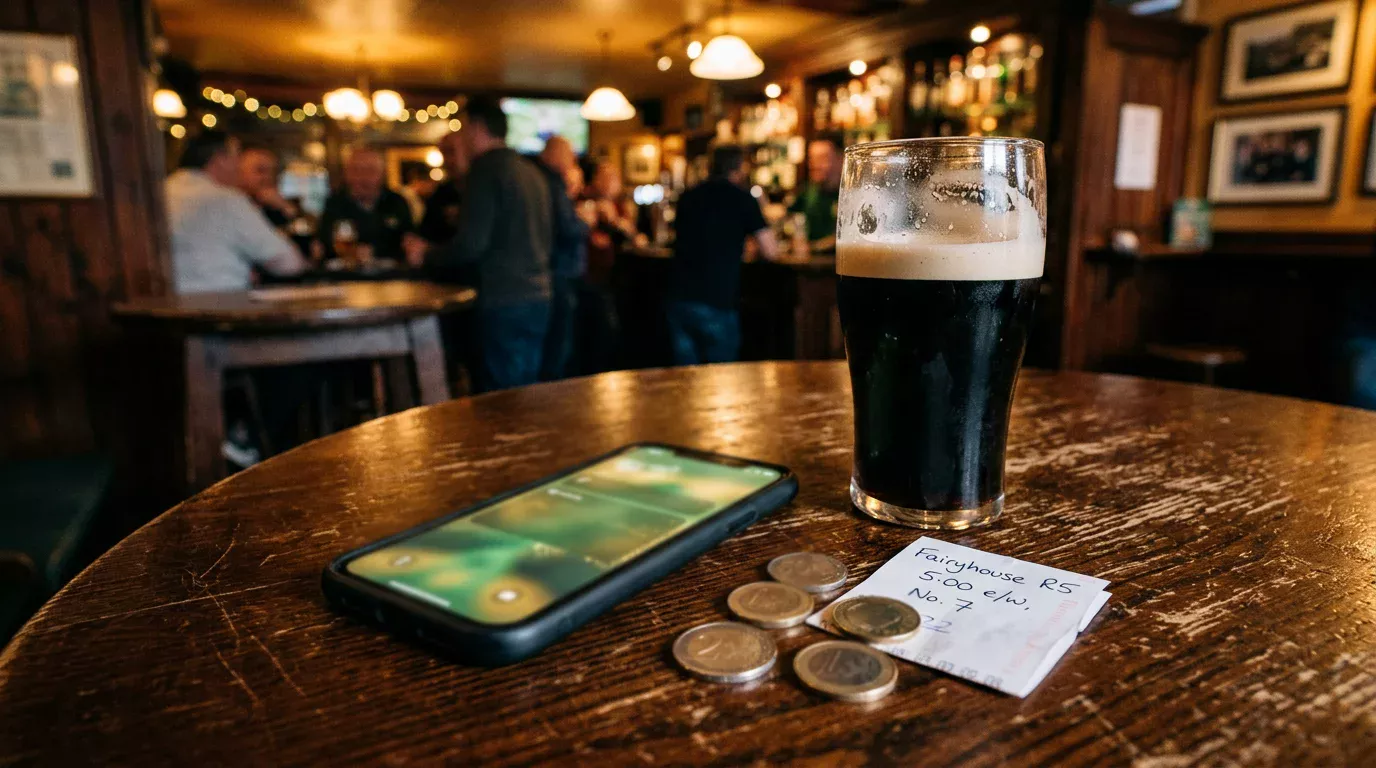
The major bookmakers operating in Ireland include several household names. Paddy Power, founded in Dublin in 1988, remains the most recognisable Irish bookmaker and offers extensive World Cup markets across pre-match and in-play betting. BoyleSports, headquartered in Dundalk, is the largest independently owned bookmaker on the island and has consistently strong football coverage. International operators including bet365, Betfair, and William Hill are also licensed to serve Irish customers and offer competitive World Cup odds.
When choosing a bookmaker for the World Cup, I look at five things: the breadth of tournament-specific markets (some platforms list 40+ markets per match, others stick to basics), the quality of in-play odds during live matches, the cash-out functionality (can I close a position mid-match, and at what margin?), the speed of withdrawals in euro, and the mobile experience — because realistically, most of your bets during a 39-day tournament will be placed from a phone at 1am while watching a match from the sofa.
A detailed comparison of bookmaker features, market depth, and what to prioritise is available in the best bookmakers for Irish punters guide. For now, the key takeaway is this: use licensed operators, understand the new regulations, and do not let any single bookmaker’s odds define your entire strategy. The differences between platforms are real, and they add up.
Five Betting Strategies That Actually Work at a World Cup
Every tournament punter has a system. Most of those systems are just superstition dressed up in spreadsheets. What follows are five approaches I have used across the last three World Cups and two European Championships — approaches grounded in patterns that hold up under scrutiny, not gut feelings about “the year of the underdog.”
Back the Draw in Opening Group Matches
The first round of group stage matches is the most cautious phase of any World Cup. Teams do not want to lose their opening fixture because it puts immediate pressure on the remaining two matches. Managers set up conservatively, star players are still finding their rhythm, and the fear of an early exit hangs over every tactical decision. At the 2022 World Cup, eight of the 16 opening group matches ended in draws or upsets. The draw in opening fixtures historically offers value because bookmakers tend to price it based on perceived team quality rather than the situational context of a tournament opener. In a 48-team format with 12 opening-round fixtures, I expect this pattern to intensify: more unfamiliar opponents, more cautious approaches, more stalemates.
Fade the Public on Marquee Matches
When Brazil play Argentina in a friendly, the public loads up on Brazil or Argentina depending on sentiment. The bookmaker adjusts the odds to balance their liability, which means the side receiving less public money often carries better value. At a World Cup, this effect is amplified. England versus Croatia in Group L will attract massive volumes from English punters backing their team. That public weight pushes England’s price down and Croatia’s price up. If my analysis says the match is closer to a coin flip than the odds suggest, I back the less popular side. Fading the public is not about being contrarian for its own sake — it is about recognising when public sentiment creates a gap between the true probability and the offered price.
Use the Group Stage to Fund Knockout Bets
I treat the group stage as an income phase and the knockouts as an investment phase. During the 17 days of group matches, I focus on high-probability singles and small accumulators — backing heavy favourites in matches where the quality gap is enormous (Germany versus Curaçao, France versus Iraq), and using the winnings to build a knockout-round bankroll. The knockout phase is where the bigger payoffs sit, but it is also where variance spikes because every match is sudden death. Having a bankroll funded by group-stage profits means I am effectively playing with “house money” from the quarter-finals onward.
Track Squad Rotation in the Third Group Match
By the time the third and final group match arrives, some teams have already secured qualification. Managers rotate their squads, resting key players ahead of the knockout rounds. This creates predictable market inefficiencies. A team that started the group with its strongest eleven may field five or six changes in the third match — and the bookmaker’s pre-tournament odds model has not fully priced that in. I look for situations where a strong team has already qualified and is resting players against a weaker team that still needs a result. The weaker team’s motivation combined with the stronger team’s rotation can make the underdog — or the draw — a genuine value play.

Set a Loss Limit Per Day, Not Per Match
This is not a market strategy — it is a bankroll strategy, and it matters more than any of the four above. A 39-day tournament with four or five matches daily creates relentless temptation to chase losses. You lose a bet on the afternoon match, so you increase your stake on the evening one. Then that loses, and the late-night fixture becomes a desperation play. I set a daily loss limit — a fixed euro amount that, once reached, means I close the app and do not place another bet until the next day. Over the 2022 World Cup, this single rule saved me more money than any clever market selection. The matches do not stop coming. You do not need to win today. There are always more fixtures tomorrow.
Kick-Off Times in Irish Time — What to Expect
Here is the reality nobody is talking about enough: this World Cup will test your sleep schedule. Ireland is five hours ahead of the US Eastern time zone during the summer, and the bulk of the tournament takes place in American stadiums with kick-offs designed for North American television audiences.
During the group stage, matches are scheduled in clusters. The earliest fixtures will kick off around midday Eastern Time, which translates to 5pm or 6pm IST — perfectly watchable. But evening and prime-time matches in the US, starting at 7pm or 9pm ET, land at midnight or 2am Irish time. Late-round group matches and knockout fixtures could stretch to 3am or even 4am IST. If you are planning to bet in-play on a quarter-final that starts at 2am, you need to be honest with yourself about whether your decision-making at that hour is as sharp as it is at 8pm.
The Mexican and Canadian venues offer slightly better time slots for Irish viewers. Mexico City is six hours behind IST, and Vancouver is eight hours behind. Matches at Estadio Azteca with a 6pm local kick-off start at midnight IST. Toronto is five hours behind, same as the US East Coast. None of these are convenient, but the Mexican afternoon fixtures — kicking off at 1pm local time, or 8pm IST — are the sweet spot for Irish punters who want to watch and bet without destroying their week.
My practical advice: build a schedule before the tournament starts. Identify which group matches and knockout fixtures you genuinely plan to watch live, and plan your betting around those. Placing pre-match bets on fixtures you will not be watching is perfectly fine. In-play betting on a match you are half-asleep in front of is a recipe for poor decisions. The late-night kick-offs also create a particular risk for accumulator bets that include one late fixture — you might be tempted to cash out or hedge at 3am under fatigue, locking in a worse position than if you had simply slept through it.
The full match schedule with every fixture converted to IST is available on the match schedule page, including the key dates you should circle now: the opening match on 11 June (likely late evening IST), England’s Group L opener, Scotland’s first fixture, and the final on 19 July.
Responsible Betting — Know Your Limits
A World Cup is the longest sustained period of betting temptation in the sporting calendar. Thirty-nine days of matches, multiple fixtures daily, markets refreshing every few minutes during live games. I have watched sharp, disciplined punters lose their composure at a World Cup because the sheer volume of action erodes their self-control by the second week.
Set your total tournament budget before the first ball is kicked. Decide on a euro amount you can afford to lose entirely — not “afford” in the sense that you will not miss it, but “afford” in the sense that losing it will not affect your ability to pay rent, buy groceries, or cover bills. That number is your World Cup bankroll. Divide it by 39 days if you want a daily guide, or allocate it by phase: a portion for the group stage, a portion for the knockouts. Once it is gone, it is gone. No top-ups, no borrowing from next month’s budget, no convincing yourself that one more bet will turn it around.
The Gambling Regulation Act 2024 introduced mandatory tools that every licensed bookmaker must provide. These include deposit limits (daily, weekly, monthly), reality checks that alert you when you have been logged in for a set period, and self-exclusion options that lock you out of your account for a defined timeframe. Use them. I set a weekly deposit limit at the start of every tournament — not because I do not trust myself, but because I know the psychology of loss-chasing at 2am after a bad beat. Everyone is vulnerable to it. The tools exist to help.
If betting stops being enjoyable — if it becomes a source of anxiety, if you are hiding the amounts you wager, if you find yourself borrowing money or skipping other spending to fund bets — seek support. Problem gambling resources in Ireland include the HSE gambling support services and GambleAware.ie, both of which offer confidential advice. A World Cup should be fun. If it is not, step away.
Your World Cup, Your Edge
The 2026 World Cup is the most complex betting tournament ever staged. Forty-eight teams, 104 matches, a new qualification format, three host nations spanning four time zones, and a regulatory environment in Ireland that has fundamentally changed how bookmakers operate. That complexity is not a barrier — it is an advantage for anyone willing to do the work.
You now understand the tournament structure, the markets available, how fractional and decimal odds translate into real money, where to place your bets legally, and five strategies that have held up across multiple tournaments. What remains is execution: picking your spots, managing your bankroll, and resisting the constant pull of a 39-day festival of football that wants you to bet more often than you should.
Ireland may be watching from the sofa again. But from that sofa, with a clear head and a sharp eye for value, you can make this World Cup count.
