
Hard Rock Stadium — World Cup 2026 Venue in Miami
 Available in US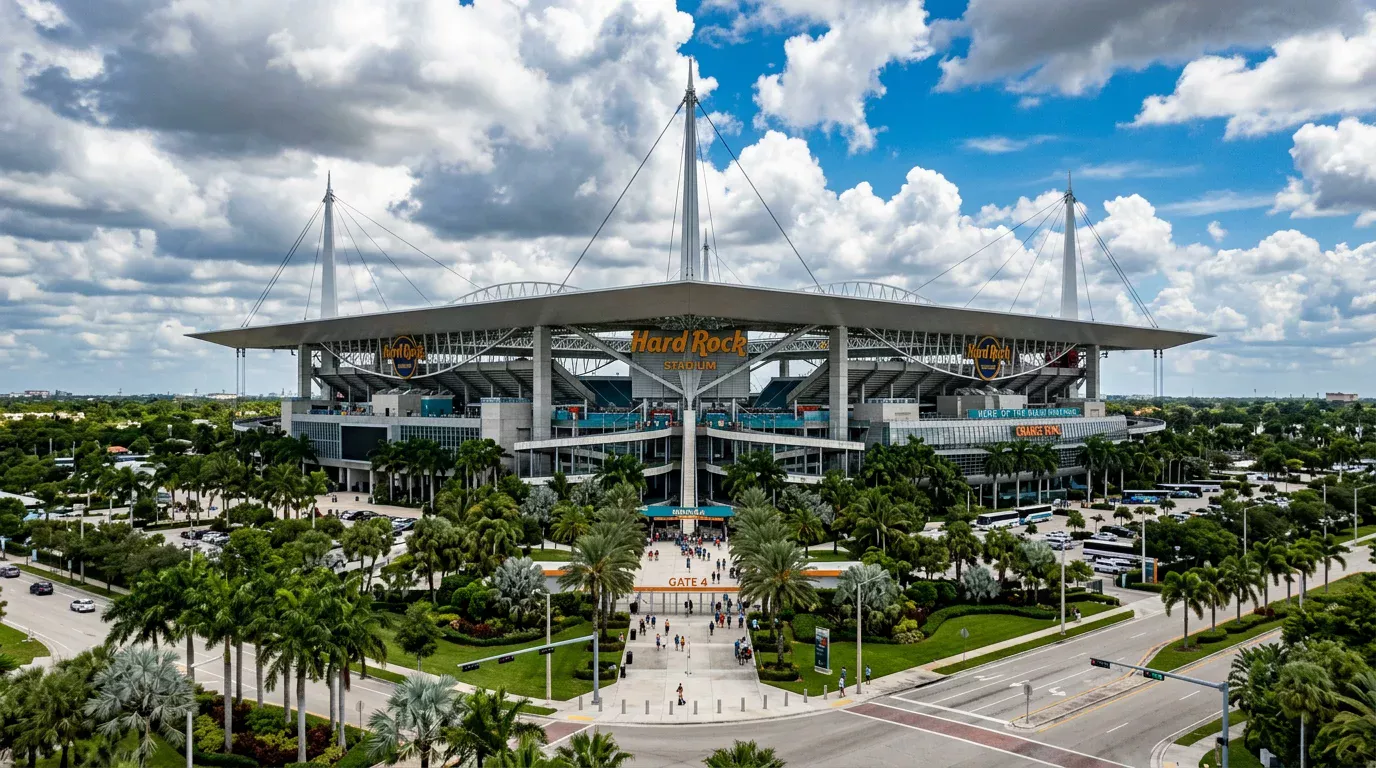
Miami in June is not for the faint-hearted. Temperatures hover around 32 degrees Celsius, humidity regularly exceeds 70%, and afternoon thunderstorms roll through with the reliability of a Swiss train. Hard Rock Stadium in Miami Gardens sits right in the middle of that subtropical reality, and for the 2026 World Cup, this climate will be as much a factor as any tactical formation or squad selection. I have watched enough tournament football to know that heat and humidity change matches — they slow the tempo, punish teams that press too aggressively, and reward squads with the fitness and rotation depth to manage their energy across 90 minutes. For punters, understanding what Miami’s climate does to football is not an optional detail. It is essential.
About Hard Rock Stadium
Hard Rock Stadium opened in 1987 as Joe Robbie Stadium and has undergone multiple name changes and extensive renovations over its nearly four-decade history. The current iteration — following a major $550 million modernisation completed in 2016 — features a partial canopy roof structure that provides shade to the majority of seating areas while leaving the pitch exposed to natural light and airflow. The stadium serves as home to the Miami Dolphins of the NFL and has hosted six Super Bowls and numerous other high-profile sporting events, making it one of the most experienced and battle-tested major-event venues in the United States.
The World Cup capacity at Hard Rock Stadium is expected to be approximately 65,000-67,000 in the football configuration, with the pitch installed to meet FIFA’s 105 by 68 metre specifications. Natural grass — which is already the standard playing surface for the Dolphins — will be maintained to FIFA’s exacting standards, and the drainage systems are well-suited to handling the afternoon downpours that are common in South Florida during June and July. The partial canopy reduces direct sun exposure for spectators but does not fully enclose the venue, meaning the heat and humidity on the pitch will be unmitigated during daytime matches. Evening kick-offs offer some relief, but even at 7pm the temperature rarely drops below 28 degrees, and the humidity lingers long after sunset.
Miami’s climate is the defining characteristic of this venue for World Cup purposes. Average June temperatures of 31-33 degrees Celsius, combined with humidity levels that can make the air feel like a wet blanket, create conditions that favour teams accustomed to tropical or subtropical environments. South American teams, Central American squads, and African nations with hot-climate experience will feel at home. Northern European sides — including several of the tournament favourites — will not. That asymmetry matters in the betting markets: a fixture between, say, the Netherlands and an equatorial African side takes on a different complexion when played in Miami’s heat compared to a cooler venue in Seattle or Vancouver. When analysing any match at Hard Rock Stadium, ask yourself one question before anything else: which team handles the heat better?
World Cup 2026 Matches at Hard Rock Stadium
Hard Rock Stadium will host group-stage matches and potentially a knockout-round fixture during the 2026 World Cup. FIFA has not confirmed the specific match allocations for individual venues, but Miami’s status as a major international city — with strong Latin American connections and a large football-supporting population — ensures it will receive high-profile fixtures. The venue is ideally suited for matches involving CONMEBOL and CONCACAF teams, whose fanbases in South Florida are large and passionate. Given the demographics of the Miami area, expect near-capacity crowds for any match involving a Latin American nation, and ticket demand for those fixtures will be among the highest at the tournament.
For Irish fans, the time zone is manageable. Miami operates on Eastern Time, which is five hours behind IST during the summer. An evening kick-off at Hard Rock — say 7pm ET — translates to midnight IST, which is late but feasible for a World Cup match. The heat factor is more relevant for betting purposes than viewing logistics: if you are placing pre-match or in-play bets on matches at Hard Rock Stadium, factor in the likelihood that the tempo will drop in the second half as players’ energy levels deplete in the humidity. Under 2.5 goals tends to hit more frequently in hot-weather venues, and second-half goals scored by substitutes are proportionally more common as tired starters are replaced by fresh legs.
Miami — What to Know
Miami is a gateway city — the point where North America meets Latin America, Caribbean culture meets American commerce, and English blends seamlessly with Spanish. For World Cup visitors, the city offers a vibrant, multicultural experience that feels unlike anywhere else in the United States. South Beach, Wynwood, Little Havana, and Brickell each have their own character, and the nightlife runs well past dawn. The food scene reflects the city’s diversity: Cuban sandwiches, Haitian griot, Colombian arepas, and Peruvian ceviche are all available within a few blocks of each other. The Art Deco architecture of South Beach and the street art of Wynwood provide a visual backdrop that makes even the walk to dinner feel like an experience worth having.
Hard Rock Stadium is located in Miami Gardens, roughly 25 kilometres north of South Beach. Transport on match days will be managed through a combination of Metrorail, dedicated shuttle buses, and ride-hailing services. Driving is common in Miami, but match-day traffic around the stadium can be severe, and parking fills early. Arriving at least two hours before kick-off is advisable, and booking return transport in advance is strongly recommended.
For Irish fans, Miami is accessible via direct flights from Dublin to Miami International Airport (MIA), with a flight time of approximately nine hours. The Irish diaspora in Florida is smaller than in New York or Boston, but the city’s international character means finding a welcoming environment is never a problem. Accommodation ranges from luxury beachfront hotels in South Beach to more affordable options in Coral Gables, Doral, and Aventura — all of which are within reasonable distance of Hard Rock Stadium.
Stadium History and Significance
Hard Rock Stadium’s history is intertwined with Miami’s identity as a major-event city. Beyond its six Super Bowls, the venue has hosted the Miami Open tennis tournament, international football friendlies, college football bowl games, and concerts by the world’s biggest artists. The 2016 renovation transformed what had been an ageing NFL stadium into a modern, multi-purpose venue capable of competing with newer facilities like SoFi Stadium and Mercedes-Benz Stadium for marquee events.
For the World Cup, Hard Rock Stadium’s significance is both sporting and cultural. Miami’s Latin American population means that matches involving South American and Central American teams will generate atmospheres closer to those found at South American World Cup qualifiers than at typical US sporting events. The noise, the colour, the passion — these are elements that Hard Rock Stadium’s matchday experience delivers in abundance, and they create an environment that benefits teams accustomed to playing in front of emotionally invested, vocal crowds. For Irish fans in the stadium, the experience will feel more like a South American away day than a neutral-venue match — and that cultural immersion is part of what makes attending a World Cup unforgettable.
Getting There From Ireland
Direct flights from Dublin to Miami International Airport (MIA) take approximately nine hours, making Miami one of the most accessible US World Cup cities from Ireland. MIA is located roughly 25 kilometres south of Hard Rock Stadium, with the journey taking 30-45 minutes depending on traffic. Irish citizens require a valid ESTA to enter the United States, and given the volume of World Cup-related travel, processing times may be longer than usual — apply at least a month before your planned departure. Hotel prices in Miami during the World Cup will be elevated — particularly in South Beach and Downtown — so booking early is essential. For better value, consider accommodation in the northern suburbs closer to Miami Gardens, where rates are lower and the commute to the stadium is shorter. Alternatively, Fort Lauderdale — just 45 minutes north of Miami — offers a wider range of affordable hotels and has its own international airport with European connections.
For the complete World Cup 2026 match schedule in Irish time, including Hard Rock Stadium fixtures, visit our dedicated schedule page.
