
Estadio Azteca — World Cup 2026 Opening Match Venue
 Available in US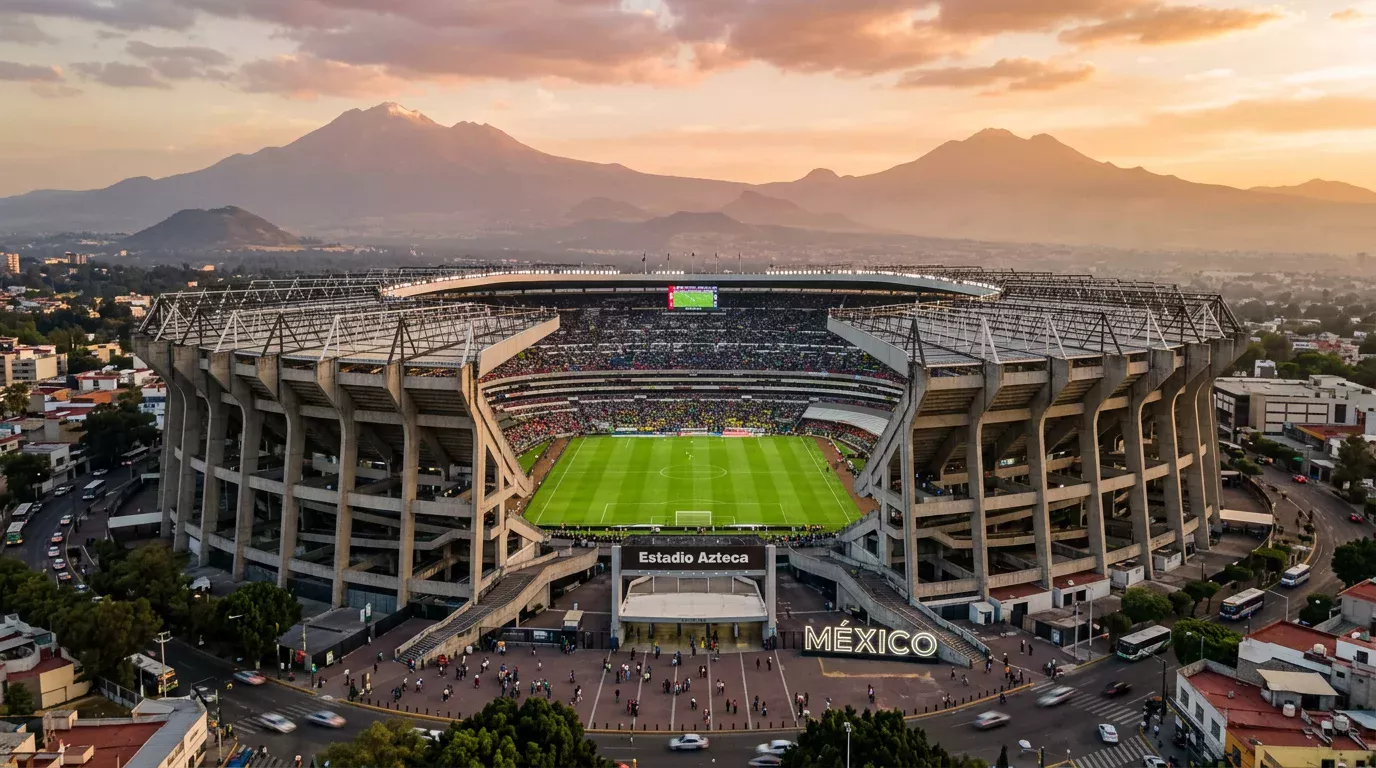
Only one stadium in the world has hosted two World Cup finals. The Estadio Azteca in Mexico City staged the 1970 final — where Pele’s Brazil demolished Italy 4-1 in what many consider the greatest team performance in football history — and the 1986 final, where Maradona’s Argentina beat West Germany 3-2. On 11 June 2026, this cathedral of football will host the opening match of the World Cup once again, when Mexico face South Africa in front of roughly 87,000 supporters. I have walked through stadiums across three continents covering tournament betting, and nothing I have experienced compares to the electricity of the Azteca when the Mexican national team takes the pitch. The altitude, the noise, and the history combine to create an atmosphere that is genuinely intimidating for visiting sides — and that matters enormously for betting markets.
About the Estadio Azteca
The Estadio Azteca was inaugurated in 1966, built specifically to host the 1970 World Cup. Designed by architects Pedro Ramírez Vázquez and Rafael Mijares Alcérreca, the stadium was conceived as a monument to Mexican football ambition — a colossal bowl carved into the volcanic landscape of the Tlalpan district in southern Mexico City. Its original capacity exceeded 100,000, though modern safety regulations and seating conversions have reduced that figure to approximately 87,000 for the 2026 World Cup configuration.
The stadium’s most significant physical characteristic is its altitude. Sitting at 2,240 metres above sea level, the Azteca presents a physiological challenge that visiting teams cannot replicate in training. The reduced oxygen levels at altitude affect aerobic capacity, meaning players who have not acclimatised will tire more quickly, particularly in the second half. This altitude factor has historically given Mexico a measurable advantage in home matches — their win rate at the Azteca in competitive fixtures is among the highest of any national team at any venue worldwide.
For the 2026 World Cup, the Estadio Azteca has undergone extensive renovation to meet FIFA’s current infrastructure standards. Upgrades to the pitch surface, seating areas, media facilities, and accessibility features have modernised the venue while preserving its iconic architectural character. The natural grass pitch — maintained at a standard that must satisfy FIFA’s meticulous requirements — measures 105 by 68 metres and drains effectively despite Mexico City’s rainy season, which coincides with the June tournament dates.
The climate at the Azteca during June is warm and humid, with afternoon temperatures typically reaching 25-28 degrees Celsius and regular afternoon rain showers. The combination of heat, humidity, and altitude creates conditions that are uniquely demanding — and uniquely advantageous for the home side. For punters, this environmental factor is not a marginal consideration. It is a central variable in any bet involving matches at the Azteca.
World Cup 2026 Matches at the Estadio Azteca
The Estadio Azteca will host the tournament’s opening match — Mexico vs South Africa on 11 June 2026 — along with additional group-stage fixtures and potentially a Round of 32 match. FIFA has confirmed the opening ceremony will take place at the Azteca before the first match, making it the focal point of the World Cup’s global launch. The exact schedule of additional matches allocated to the venue is subject to FIFA’s final confirmation, but the Azteca is expected to host between five and seven matches across the tournament.
The opening match carries particular significance for the betting markets. Mexico’s home advantage at the Azteca is well-documented, and their odds to win the opening fixture against South Africa reflect that edge — expect Mexico to be priced at around 2/5 or shorter. The altitude factor alone shifts the balance: South Africa will have had limited time to acclimatise, and the thin air will blunt their pressing game in the second half. Mexico to win and over 1.5 total goals is the kind of opening-match accumulator leg that tournament punters traditionally lean on.
For Irish fans watching the opening match, the kick-off time in IST will depend on the local start time — a late afternoon kick-off in Mexico City (roughly six hours behind IST) would translate to a late evening start in Ireland, making it a comfortable viewing experience for the tournament’s curtain raiser.
Mexico City — What to Know
Mexico City is one of the largest metropolitan areas on earth, with a population exceeding 21 million in the greater urban zone. For World Cup visitors, the city offers an extraordinary cultural backdrop: pre-Columbian archaeological sites, world-class museums, a street food scene that rivals any city globally, and a nightlife that runs until dawn. The Zocalo — the massive central plaza in the historic centre — will serve as a natural gathering point for fans, with FIFA Fan Zones expected in surrounding areas.
The Estadio Azteca is located in the Tlalpan borough, in the southern part of the city. Access by public transport is straightforward — the Mexico City Metro’s Line 2 runs to the Taxquena station, from which dedicated shuttle services and the Tren Ligero light rail connect to the stadium area. Taxi and ride-hailing services are abundant, though match-day traffic around the Azteca can be severe. Arriving early — at least two hours before kick-off — is strongly recommended.
For Irish visitors, Mexico City is accessible via connecting flights through the United States or direct services from European hubs. The flight time from Dublin via a US connection is approximately 14-16 hours depending on the layover. Accommodation options range from luxury hotels in Polanco and Condesa to budget-friendly hostels in Roma Norte, and the favourable Euro-to-Mexican Peso exchange rate means the city is remarkably affordable compared to US venues. A pint of local craft beer will cost a fraction of what you would pay in New York, and the street tacos — the real ones, from stalls that have been there for decades — are worth the trip alone.
Stadium History and Significance
The Estadio Azteca is more than a football stadium — it is a shrine. This is the ground where Maradona scored the “Goal of the Century” against England in the 1986 World Cup quarter-final, weaving past five defenders and the goalkeeper in a run that has been replayed billions of times. It is where Pele’s Brazil played the most complete football the World Cup has ever seen. It is where Mexican football found its identity and where generations of supporters have experienced the highest highs and lowest lows of the beautiful game.
The 2026 World Cup marks the Azteca’s third time hosting World Cup matches, a distinction no other stadium holds. Its continued relevance — 60 years after it was built — speaks to a design that was ahead of its time and a cultural significance that transcends architecture. The renovation work completed for 2026 has brought the facilities into the modern era while respecting the stadium’s heritage, ensuring that the Azteca remains worthy of hosting the biggest matches in football. For the opening match of the biggest World Cup in history, there is no more fitting stage. The roar of 87,000 voices at the Azteca when Mexico score their first goal of the tournament will be heard across the footballing world.
Getting There From Ireland
Ireland does not have direct flights to Mexico City, so Irish fans will need to connect through a US hub — typically Miami, Houston, Dallas, or Atlanta — or through a European hub like Madrid or Amsterdam. Total travel time from Dublin to Mexico City’s Benito Juarez International Airport (MEX) is approximately 14-16 hours including the layover. The airport is located within the city, roughly 30 minutes from the historic centre and 45 minutes from the Estadio Azteca by car.
Visa requirements for Irish citizens travelling to Mexico are straightforward: Ireland is on the visa-exempt list, allowing stays of up to 180 days for tourism. However, if your connecting flight routes through the United States, you will need a valid ESTA (Electronic System for Travel Authorization) or US visa — a detail that catches out many European travellers. Apply for the ESTA well in advance of your trip to avoid last-minute complications. Travel insurance covering medical expenses is also strongly recommended, as healthcare costs in Mexico can be significant for uninsured visitors.
For the complete World Cup 2026 match schedule in Irish time, including all Estadio Azteca fixtures, check our dedicated schedule page.
